What does it really take to move from first solo to a mission-ready crew member in search and rescue?
This introduction defines the scope of the U.S. path for becoming eligible to serve in demanding rescue roles. It covers FAA eligibility, medical classes, ground study, logged flight hours, and the stepwise progression from private to commercial and beyond.
The narrative explains why solid knowledge of rules and structured training matter for safety and career growth. Readers will see typical timeframes, cost ranges, and hour minimums that shape realistic plans.
Practical links guide candidates to deeper how-to resources, including a concise guide on how to acquire a helicopter license, and preview topics on selecting school, logging efficient flight time, and passing written and practical exams.
Key Takeaways
- FAA rules set age, ID, English, and medical standards that candidates must meet.
- Training mixes ground school, logged flight hours, and staged exams.
- Common pathway: private license → commercial license → advanced ratings.
- Costs and time vary; plan for several thousand dollars and months to years.
- Structured training and clear goals speed progress toward mission-ready status.
Understanding The Scope: What “SAR Helicopter Pilot Licensing Requirements” Covers Today
This overview explains which licenses, ratings, and core knowledge form the pathway to mission-ready crew status in U.S. aviation.
FAA pathways span private (PPL), commercial (CPL), and airline transport (ATPL) certificates. Instrument proficiency is highly recommended for all-weather flight and real missions. Candidates must show English proficiency and pass written and practical exams.
Practical scope includes the baseline eligibility checks—age, identity, medical certification—and the layered training that moves a candidate from solo work to paid operations.
- Which pilot licenses are essential versus advantageous
- How ground knowledge links to safe flight performance
- Choosing a training provider that follows FAA standards
Pilots benefit from a clear step framework: study, flight practice, staged exams, and performance tracking. For timelines, intensive full-time programs can finish in ~15 months, while many trainees take 1–2 years to reach a commercial certificate from zero time.
For curriculum alignment and position-specific guidance, review this training checklist.
Mapping The License Path: Private, Commercial, Instrument, And Beyond
Mapping the license ladder helps candidates see the stepwise skills and time needed to move from private training to advanced certificates.
Private Pilot License (Rotorcraft-Helicopter): Foundation For Skills
The private pilot license starts with an FAA written, practical test, and a minimum of about 35–40 total hours depending on program. Training focuses on basic maneuvers, safety procedures, and solo flight experience.
Commercial Pilot License: Required For Paid SAR Operations
A commercial license requires at least 150 total hours with set dual, solo, cross-country, and instrument training elements. The commercial test demands higher precision, advanced decision-making, and polished airmanship for compensated work.
Instrument Rating: All-Weather Proficiency For Rescue Missions
The instrument rating teaches IFR procedures, approaches, and low‑visibility decision rules. This certificate improves mission reliability when weather or visibility degrade.
Airline Transport Pilot Certificate: Advanced Credentialing
ATPL candidates must be 23, hold a commercial and instrument rating, pass FAA written and practical exams, hold a First‑Class Medical, and meet high total‑time benchmarks (many programs cite ~1,200 hours).
“Each certificate builds targeted skills; recurrent training keeps those skills ready for real operations.”
Eligibility And FAA Medical Standards For Prospective SAR Helicopter Pilots
Before logging solo time, applicants need to meet clear age, identity, language, and medical checkpoints set by the FAA. These gates protect students and the flying public while keeping training on schedule.
Age, Citizenship/Identity, And English Proficiency
Minimum ages are set by certificate tier: 17 for a private pilot license, 18 for a commercial pilot license, and 23 for an ATPL. Students must also verify identity and apply for a student pilot certificate before solo operations.
English proficiency is mandatory to ensure clear, standardized phraseology with ATC and crews. Demonstrable language ability reduces miscommunication during critical flight phases and tests.
FAA Medical Certificates: Third, Second, And First Class
Medical classes align with operational privileges. A third-class medical commonly supports a private license, a second-class is standard for commercial duties, and a first-class is required for ATPL privileges.
All medicals must be obtained through an FAA-authorized Aviation Medical Examiner (AME) and kept current. Schedule the FAA medical early to avoid delays in solo or practical test eligibility.
- Track medical validity dates and student documentation to avoid gaps before a practical test.
- Plan renewals around training timelines to maintain continuous flight privileges.
- Citizenship is not required, but acceptable ID and residency documents are needed for enrollment and TSA-related steps.
| Certificate | Minimum Age | Typical Medical Class |
|---|---|---|
| Private Pilot License | 17 years | Third Class |
| Commercial Pilot License | 18 years | Second Class |
| Airline Transport Pilot | 23 years | First Class |
“Early attention to medical and identity steps keeps training timelines predictable and supports professional objectives.”
Choosing A Flight School And Ground Training That Prepare You For SAR
A candidate’s school choice should prioritize structured ground study and predictable aircraft availability.
Evaluating Flight School Quality And Training Environment
Look for a flight school with a clear safety culture, experienced instructors, and modern maintenance practices. Verify fleet mix, dispatch reliability, and average time to checkride. Ask about graduate outcomes and how the school supports scheduling and test prep.
Core Ground School Topics: Regulations, Navigation, Systems, Emergencies
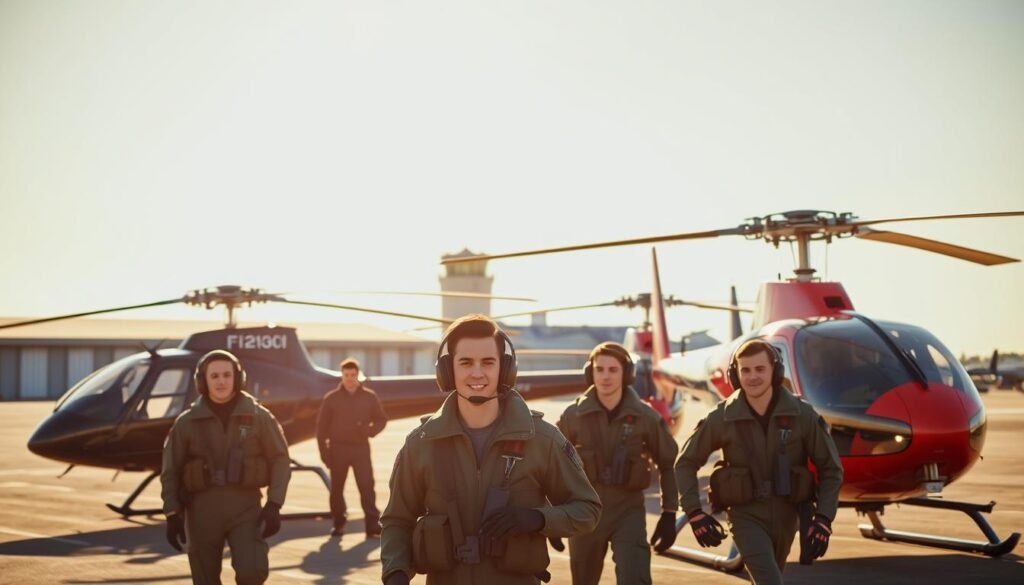
Reputable programs offer ground blocks on systems, performance, regulations, navigation, meteorology, and emergency procedures. One-on-one instruction and structured briefings improve retention and decision-making.
- Compare syllabi and simulator access for realistic scenario practice.
- Check instructor experience with instrument work, night ops, and emergency drills.
- Use proven texts like the Helicopter Flying Handbook and mock tests to pass written exams.
“Structured ground training and reliable flight access shorten timelines and build confidence.”
For guidance on selecting an academy, review this leading helicopter academy guide.
Flight Training And Hours: Meeting Minimums And Building Proficiency
Careful logging and planned exposure to diverse conditions make the difference between meeting minimums and being truly ready.
Logging Flight Time: Dual, Solo, Cross-Country, And Instrument
Students must log dual instruction, solo practice, cross-country legs, and instrument exposure precisely. Entries should note PIC or dual, maneuvers practiced, and conditions. Clear logs speed checkride scheduling.
Typical Hour Minimums: Private Versus Commercial Helicopter
Private training commonly requires 35–40 hours total, including dual and solo segments. Commercial certification requires at least 150 hours total with roughly 100 hours PIC, 20 hours of training, and 10 hours solo.
Developing Critical Maneuvers: Hovering, Autorotation, Emergencies
Lessons should sequence hovering, confined-area work, autorotations, and emergency drills. Scenario-based practice in wind and varied density altitude builds resilient skills.
- Monitor progress against syllabus milestones and log entries accurately.
- Use instructor feedback and debriefs to shorten overall training time.
- Plan cross-country routes to meet time needs and reinforce navigation.
- Seek early instrument exposure for better all-weather confidence.
“Disciplined practice and precise logging turn minimum hours into dependable capability.”
| Certificate | Typical Total Hours | Key Logged Components |
|---|---|---|
| Private | 35–40 | Dual, Solo, Cross-Country, Basic Maneuvers |
| Commercial | 150 (min) | 100 PIC, 20 Training, 10 Solo, Instrument & Cross-Country |
| Training Focus | — | Hovering, Autorotation, Emergencies, Density Altitude |
Exams And Checkrides: Passing Knowledge And Practical Tests
Testing day combines focused knowledge review with a calm, structured routine that helps candidates perform at their best.
The process includes two linked stages: a written knowledge test and a practical checkride. Each stage validates different skills and together they confirm readiness for advanced certificates and flight operations.
Written Knowledge Tests: Content, Prep Materials, And Timing
The written test covers airspace, weather, navigation, and helicopter systems. Study blocks should align with topics to build deep understanding rather than surface memorization.
Recommended prep: formal ground instruction, the FAA handbooks, focused study guides, and timed practice exams. Scheduling the exam during peak study momentum often helps candidates pass written more reliably.

Practical Test Standards: Oral Exam And Flight Evaluation
The practical checkride begins with an oral exam on systems, regulations, and scenario judgment. The flight evaluation tests takeoffs, landings, hovering, autorotation, and emergency procedures against the Airman Certification Standards or Practical Test Standards.
Designated examiners assess risk management, checklist discipline, and decision-making. Structured instruction and targeted practice reduce gaps before the checkride.
“Mastery, not minimum passing, correlates with safer operations and greater mission success.”
- Assemble documentation: medical, endorsements, logbook entries, and certificates before scheduling.
- Use post-practice debriefs to correct patterns and refine briefings.
- Practice stress management: brief the flight, control breathing, and follow checklists.
- Reference the interagency standards for practical-test expectations: Practical Test Standards.
| Exam Component | Focus Areas | Success Tips |
|---|---|---|
| Written Knowledge Test | Airspace, Weather, Navigation, Systems | Timed practice tests, focused ground instruction |
| Oral Exam | Regulations, Systems, Scenario Judgment | Use scenario drills and briefing templates |
| Flight Evaluation | Takeoffs, Hovering, Autorotation, Emergencies | Progressive practice, simulator work, checklist discipline |
SAR Helicopter Pilot Licensing Requirements
Agencies expect more than certificates; documented, diverse flight experience often decides hiring outcomes.
Core FAA Licenses For SAR Readiness
The commercial pilot certificate is the common minimum for paid rescue roles. Many operators also require an instrument rating to support low‑visibility and all‑weather flight.
Experience Expectations For Operational SAR Roles
Teams evaluate cumulative flight hours, PIC time, and mission‑specific training. Night operations, marginal weather, and complex terrain experience are frequently listed as essential.
Recurrent checks and scenario training keep crews standardized. Agencies often add endorsements for external load work or specialized hoist operations.
- Minimum: commercial certificate plus instrument proficiency preferred.
- Operational value: significant PIC hours beyond FAA minimums.
- Ongoing: periodic evaluations and crew resource management training.
“Licenses are the foundation; depth and variety of flight experience make candidates mission-ready.”
| Criterion | Typical Expectation | Why It Matters |
|---|---|---|
| Pilot License | Commercial (min); Instrument preferred | Allows paid operations and IFR capability |
| Flight Experience | Hundreds of PIC hours; night and marginal-weather exposure | Demonstrates reliable decision-making under stress |
| Recurrent Training | Annual or semi-annual evaluations | Maintains standards and team coordination |
Candidates should plan a career path that builds diverse flight time and relevant endorsements. For related career guidance, review this Canadian military recruiting overview at forces.ca pilot careers.
Pathways Into SAR: Military, Coast Guard, And Public Safety Aviation
Entry into mission flying usually blends formal training, operational tours, and focused mission experience.
The most direct routes are military aviation, coast guard service, and state or local public-safety units. Each path gives different types of operational exposure and progression timelines.
U.S. Coast Guard SAR Pilots: Second-Tour Qualification And Alaska Mission Demands
The U.S. Coast Guard assigns Alaska crews who are second-tour and fully mission qualified. These aviators typically have at least four years of experience and complete a season-by-season exposure syllabus to master local hazards.
State And Local Public Safety Aviation: Police, Fire, And EMS Support
Police, fire, and EMS aviation units hire pilots with documented flying competencies, clean background checks, and fitness for duty. Agencies often coordinate with regional training centers and require additional certifications for specific missions.
Building A Competitive Resume: CFI Time, Instrument Proficiency, And Mission Training
Certified flight instructor time helps candidates build PIC hours efficiently and shows instructional leadership. Instrument and night experience, overwater and mountainous training, and hoist or external-load exposure increase job prospects.
“Depth and variety of flight experience make a candidate more competitive for challenging assignments.”
| Pathway | Typical Least Years | Key Experience |
|---|---|---|
| Military Aviation | 3–6 years | Medevac, tactical ops, large-scale deployments |
| U.S. Coast Guard (Alaska) | 4+ years | Seasonal exposure syllabus, advanced maritime ops |
| Public Safety Units | 2–5 years | Night ops, EMS support, regional training coordination |
Costs, Timelines, And Training Intensity In The United States
Costs and time vary widely across programs, so candidates should budget realistically for each step. Location, aircraft hourly rates, and instructor continuity drive the largest differences in total spend and hours.
Typical Budget Ranges From Private Through Commercial And CFI
Private (PPL): $12,000–$20,000. Commercial (additional): $18,000–$40,000. CFI Path: $38,000–$70,000.
These ranges depend on how many hours a student needs beyond minimums, examiner fees, medicals, study materials, and checkride costs.
Full-Time Versus Part-Time Training Timelines
Full-time programs can finish in roughly 15 months at some academies. Zero-to-CPL can take 1–2 years full-time, or 2–4 years part-time.
Full-time study preserves momentum and often reduces total hours and cost. Part-time students should plan for weather delays and gaps that can add lessons.
- Plan contingency hours beyond legal minimums for repeat practice or poor weather.
- Include tuition, examiner fees, medical exams, and materials in budget forecasts.
- Evaluate loans and scholarships early to maintain training cadence.
| Stage | Typical Cost Range | Common Timeframe |
|---|---|---|
| Private | $12,000–$20,000 | Months (variable) |
| Commercial | $18,000–$40,000 | Months to 1 year |
| CFI | $38,000–$70,000 | Additional months |
“Choose a school with transparent progress tracking so each step is predictable and supports efficient completion of the process.”
Safety, Compliance, And Career Progression For SAR Helicopter Pilots
Keeping crews mission-ready requires a formal cycle of checks, scenarios, and measured escalation of difficulty.
Operational Risk Management And Recurrent Training
Operational risk management is a continuous process. Units require scheduled recurrent training, standardization flights, and formal scenario refreshers to limit exposure to avoidable risk.
Documented checks and simulators reinforce decision rules and checklist discipline. Standard operating procedures tie compliance to safety culture and promotion paths.
Advancing Skills: Night, IFR, Mountain, And Maritime Operations
Advanced skill blocks add layers to a career plan. Night operations, IFR procedures, mountain techniques, and maritime work are inserted as staged syllabi.
Quality instruction and logged proficiency support selection for high-tempo missions and specialized roles. Certificates and endorsements—plus verified least years of service and experience—determine eligibility for units with demanding environments.
Crews should integrate crew resource management, SIM sessions, and after-action reviews into routine practice. These tools convert training into reliable, repeatable flight performance and long-term career growth.
“Recurrent practice and clear documentation make career advancement predictable and safety measurable.”
| Focus Area | Typical Expectation | Career Impact |
|---|---|---|
| Recurrent Checks | Annual or semi-annual | Maintains currency and standardization |
| Advanced Syllabi | Night, IFR, Mountain, Maritime | Unlocks specialized assignments |
| Documented Experience | Logged PIC hours and endorsements | Supports selection and promotion |
Final Thoughts
Closing the Loop: Follow each clear step—meet FAA eligibility, secure an FAA medical, complete ground and flight training, and pass the written and practical test—to become helicopter pilot ready for operational roles.
Minimum hours are a baseline. Exceeding those hours through targeted training and certified flight instruction builds confidence and makes candidates more competitive for a job in mission flying.
Plan budgets and timelines realistically, keep study disciplined to pass written exams, and translate knowledge into safe helicopter flight through regular practice. For detailed study materials, see the study reference guide for pilot licences.
Takeaway: Treat each milestone as a step toward the helicopter pilot license. Seek quality instruction, log diverse hours, and pursue mission-specific training to enter search and rescue roles with confidence.