Can Anyone Learn to Fly a Helicopter is a question that sparks doubt and dreams in equal measure.
What really separates a curious person from a licensed helicopter pilot? The answer lies in clear steps, steady practice, and meeting FAA rules.
Most healthy people with correctable vision and normal coordination can progress from a first lesson to solo at 16 and a private certificate at 17. Training blends ground school, logged flight hours, and FAA knowledge and practical tests.
The path includes private, commercial, and instructor ratings, each with age and medical requirements. Costs, realistic timelines, and skill goals vary, but structured helicopter flight training and consistent practice shorten the road to competence.
For a practical step-by-step overview of certification, timelines, and career options, see this helpful guide from PilotMall: How to Become a Helicopter Pilot.
Key Takeaways
- Most healthy individuals can complete helicopter training with commitment and good judgment.
- Training requires ground school, logged flight time, and passing FAA written and practical exams.
- FAA age minimums: solo at 16, private at 17, commercial/CFI at 18; no upper age limit.
- Costs and hours vary by certificate; consistent scheduling improves progress and safety.
- Core helicopter skills include hovering and autorotation; schools and materials guide exam prep.
Can Anyone Learn to Fly a Helicopter: What It Takes To Get Started
Becoming a rotorcraft pilot begins with a few factual steps. Prospective students confirm eligibility: solo at 16, private pilot at 17, commercial and CFI at 18. They must prove English proficiency and schedule an FAA medical with an Aviation Medical Examiner before any solo flights.
Next, secure a student pilot certificate and enroll in ground school. Dual instruction starts almost immediately. No prior airplane experience is required, so many begin with an introductory lesson to test aptitude and interest.
Early planning reduces total flight hours. Regular lessons and a clear training plan that mixes ground theory and in-flight practice speed progress. Budgeting is important: include course materials, headsets, written test fees, and checkride expenses.
Onboarding should cover school tours, instructor meetings, and fleet reviews. New students learn radio basics, preflight checks, and airport routines from day one.
- Confirm age, ID, and medical eligibility
- Get a student certificate and start dual instruction
- Choose a school, set a schedule, and budget early
| Starter Step | What It Means | Typical Timeframe |
|---|---|---|
| Eligibility Check | Age limits, English, medical screening | Days to weeks |
| Student Certificate | Paperwork and identity verification | 1–4 weeks |
| Training Plan | Ground school + scheduled flight lessons | Months, depending on pace |
| Intro Flight | Hands-on skill check, no prior fixed-wing required | Single session |
For a step-by-step certification overview, see this guide on how to become a helicopter pilot in five easy.
Helicopter Pilot Licenses: Private, Commercial, And Beyond
Each helicopter license level builds on the last, combining age limits, flight time, and medical standards that match the role’s responsibility.
Private Helicopter License (PPL): Minimum Ages, Flight Hours, And Privileges
The private pilot certificate requires a minimum age of 17. Under Part 61 the legal minimum is 40 hours, though many students log 50–60 hours. Some accelerated programs cite a 35-hour curriculum, but most pilots need extra practice before the checkride.
Privileges are strictly non-commercial: holders may carry passengers but not accept compensation. Training centers on hovering, basic navigation, radio communications, emergency procedures, and safe local or cross-country operations.
Commercial Pilot License (CPL): Added Requirements, Flight Hours, And Career Paths
To pursue a commercial pilot rating, candidates must be at least 18 and hold a private pilot certificate. The commercial helicopter route requires about 150 total hours with specified PIC, dual, solo, instrument, and cross-country time.
Commercial license standards raise proficiency expectations and introduce advanced maneuvers and instrument work. Graduates can pursue aerial tours, utility work, firefighting support, EMS, and photography after operator-specific training.
Airline Transport Pilot And Instructor Pathways: Instrument Rating, CFI, And CFII
The Airline Transport Pilot track is the senior path: age 23, an instrument rating, about 1,200 hours, and a first-class medical are typical requirements. This supports passenger-carrying and high-responsibility operations.
Instructor options (CFI and CFII) follow the commercial and instrument steps. Earning instructor certificates provides a structured way to build hours, mentor students, and advance a career while improving judgment and teaching skills.
“Progressing through certificates unlocks new privileges while sharpening decision-making and safety margins.”
For a step-by-step certification overview, see this how to become a helicopter pilot.
FAA Eligibility And Medical Certificate Requirements
Entry into rotorcraft training requires verified identity, English skills, and an approved medical evaluation. The federal aviation administration sets age and medical milestones that shape every training plan.
Age, Citizenship, And English Language Proficiency
Students must meet clear age minimums: 16 for solo, 17 for a private pilot license, 18 for commercial and CFI, and 23 for ATP. English proficiency is mandatory for safe radio and crew communication.
Citizenship is not required, but applicants need valid identity and residency documents for a student pilot certificate and TSA/FAA verification before solo privileges.
FAA Medical Certificate Classes: Third-, Second-, And First-Class
The right medical certificate depends on goals. A third-class covers private pilots. A second-class medical supports commercial privileges. A first-class is required for ATP roles.
Candidates schedule exams with an Aviation Medical Examiner. The exam checks vision, cardiovascular and neurological health, and basic fitness. Some conditions may need extra paperwork or specialist reports.
Student Pilot Certificate And Identity Verification
Student pilot certificates are requested online and require identity checks before solo flight. Keep both the student certificate and current faa medical certificate on hand during solo and at checkrides.
“Plan medical renewals around major milestones to avoid training delays.”
- Verify age thresholds and English ability early.
- Book an AME, bring medical history, and ask about renewals.
- Carry student and medical certificates during solo and tests.
| Requirement | Applies To | Typical Note |
|---|---|---|
| Third-Class | Private pilot | Valid for most private training |
| Second-Class | Commercial work | Needed for paid operations |
| Student ID | Solo privileges | Requires TSA/FAA identity verification |
For detailed medical steps and documentation, review the medical requirements for helicopter pilots.
Helicopter Flight Training Path In The United States
A clear training path ties ground lessons on systems and regulations to in-flight practice under a watchful instructor.
Ground School Fundamentals: Systems, Regulations, Navigation, And Emergency Procedures
Ground school covers helicopter systems, airspace rules, navigation, weather, and emergency procedures.
Students use the Helicopter Flying Handbook and ASA kits as standard references for the knowledge test and daily lesson prep.
Short study blocks for meteorology, performance calculations, and navigation make checkride topics easier to retain.

Flight Instruction And Logging Flight Hours With A Certified Flight Instructor
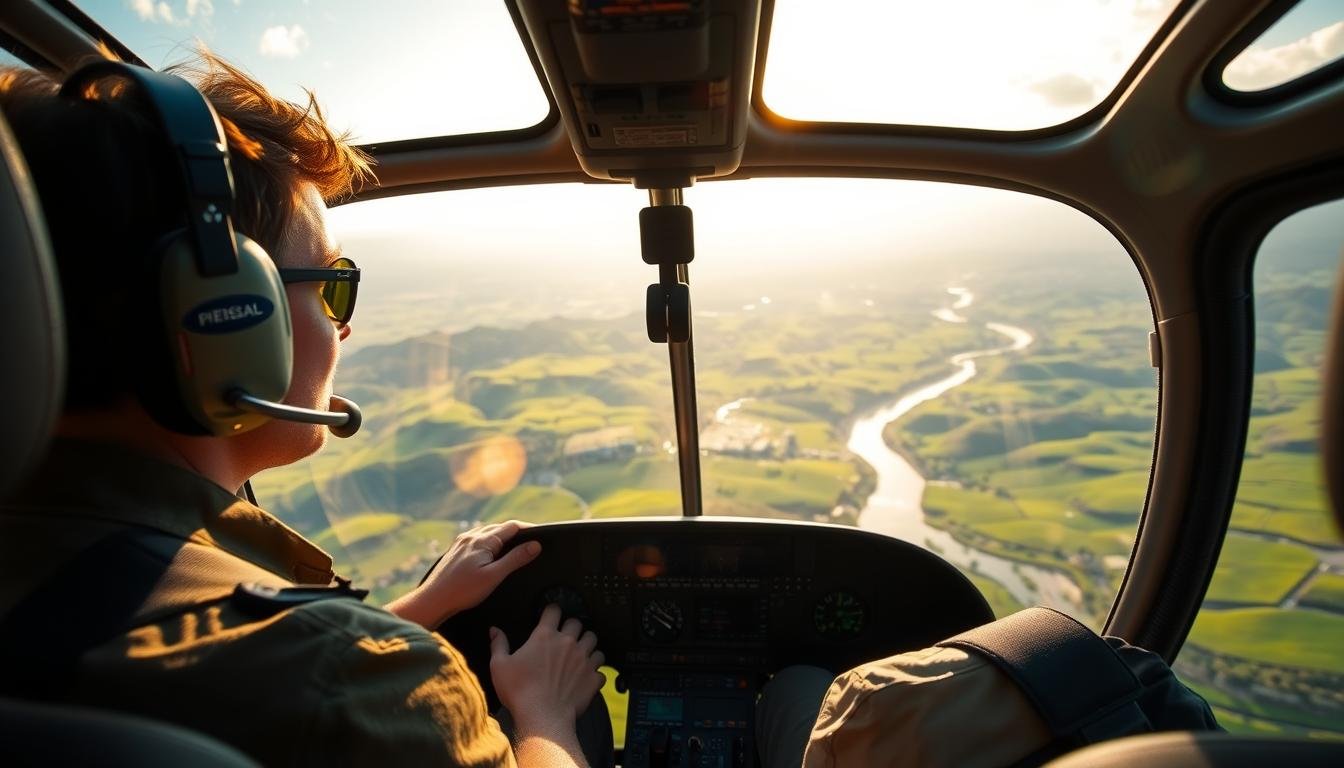
With a certified flight instructor, students begin control coordination, move to hovering and pattern work, then practice cross-country skills.
Instructors endorse solo flights only after performance, safety, and student paperwork are verified.
Accurate logbook entries for dual lessons, solo time, and cross-country segments are essential to meet minimums for each pilot certificate.
- The training path links classroom topics directly to cockpit tasks for faster skill transfer.
- Structured syllabi sequence takeoffs, landings, confined-area work, and introductory autorotation practice.
- Frequent scheduling preserves muscle memory and reduces total flight hours needed.
- Preflight briefings, chair flying, and focused debriefs accelerate progress between lessons.
- Evaluate schools by safety culture, maintenance records, scheduling flexibility, and student outcomes.
Practical tip: Review instructor resumes and ask about average student hours to private pilot completion before enrolling.
“Consistent lessons and clear logging make the path from dual instruction to solo straightforward and verifiable.”
For a stepwise certification overview and timelines, see this training guide and this article on training requirements at Helicopted.
Training Time And Costs For Helicopter Pilots
Training length and price depend heavily on lesson frequency, aircraft type, and local weather. These factors determine whether a student finishes quickly or spends the least years building competence.
Typical Timelines: Full-Time Versus Part-Time, And Minimum Flight Hours
Full-time programs often reach a commercial license within 1–2 years. Part-time students commonly need 2–4 years because gaps between lessons increase total flight hours required.
Minimum flight hours under Part 61: private pilot shows a 40‑hour legal minimum (most log 50–60), while commercial requires about 150 total hours. Most students exceed minima to reach safe proficiency.
Cost Ranges By Certificate And Funding Options
Typical direct costs vary by region and machine. Private training usually runs $12,000–$20,000. Adding a commercial certificate often adds $18,000–$40,000. A CFI path can total $38,000–$70,000.
Budget items include aircraft rental, instructor time, ground instruction, books, headsets, written exam fees, and checkride/aircraft fees. Plan for fuel surcharges, retests, and extra lessons.
- Financing: private loans, school plans, and scholarships are common—apply early and compare terms.
- Medical planning: obtain and maintain the second-class medical before commercial work to avoid training delays with FAA medical requirements.
- Value tips: frequent lessons, simulator or chair-flying practice, and tracking lesson frequency reduce total cost per hour.
“Consistent scheduling and clear budgeting are the best defenses against unexpected delays and higher bills.”

For course options and certification pathways, see this training programs and certifications guide.
Skills You Need And How Hard It Really Is
Mastering helicopter controls takes focused practice, but steady lessons turn awkward inputs into smooth coordination. Early training stresses simple, repeatable drills that build confidence and reduce workload in flight.
Core Controls
Core Helicopter Skills: Cyclic, Collective, Pedals, Hovering, And Autorotation
Students learn how cyclic, collective, and anti-torque pedals interact and why small, smooth inputs matter. Scan discipline—watching instruments and outside references—keeps the aircraft stable.
Hovering is introduced as the most challenging early skill. Repetition with coaching develops fine motor control until hovering feels instinctive.
Autorotation training builds trust that a safe descent is possible after engine loss. Pilots practice energy management, the flare, and touchdown technique at altitude first, then lower altitudes as skill improves.

Safety Mindset: Weather Decisions, Judgment, And Emergency Procedures
Workload management is vital. Students learn to stay ahead of the aircraft, brief approaches, and use checklists to standardize performance.
Safety training covers personal minimums, conservative weather choices, terrain and obstacle awareness, and maintaining safe altitudes near built-up areas. Many accidents stem from poor judgment—press-on-itis, scud running, and wire strikes.
- Practice briefings and scenario-based drills with a flight instructor to sharpen judgment.
- Use chair-flying and radio phraseology practice to reduce cockpit workload.
- Fixed-wing pilots making the switch should treat rotorcraft skills as a fresh discipline; some knowledge transfers, but control techniques differ. See this guide on transitioning from fixed-wing.
“Ongoing proficiency flights and recurrent training keep safety margins high for helicopter pilots at every experience level.”
Passing FAA Exams And Earning Your Pilot Certificate
Final certification requires both knowledge and demonstrated flying skill under federal aviation administration standards.
Students face two key milestones: the written knowledge test and the practical checkride. Each step verifies different competencies required for a private pilot or other ratings.
Written Knowledge Test: Study Topics And Prep Strategies
The written exam evaluates airspace structure, weather interpretation, performance, navigation, and helicopter-specific systems and limitations.
Effective prep uses handbooks, question banks, and timed practice exams to build speed and accuracy so candidates comfortably pass written requirements.
Plan study blocks for meteorology charts, FAA publications, and performance calculations. Fixed-wing pilots adding rotorcraft may face slightly different question sets; confirm the test version before registering.

Practical Checkride: Oral, Maneuvers, Standards, And Sign-Offs
The practical test starts with an oral on regulations, systems, weight and balance, and risk management scenarios. Examiners expect clear, concise answers and sound risk decisions.
In flight, applicants show normal and crosswind takeoffs and landings, hovering, slope operations, autorotations, and emergency procedures to standard.
A flight instructor endorsement confirms readiness. The examiner will verify required flight hours, training, and logbook endorsements before grading the checkride.
- Bring organized documents: pilot and medical certificates, knowledge test report, ID, aircraft records, and logbook with endorsements.
- Use mock orals, chair-flying maneuvers, and briefing drills to build consistency and confidence.
- If weather or maintenance forces a delay, reschedule promptly and review debrief notes to target weak areas.
| Exam Part | Main Focus | Typical Prep |
|---|---|---|
| Written Knowledge | Airspace, weather, navigation, systems | Handbooks, question banks, timed tests |
| Oral Exam | Regulations, planning, weight & balance | Mock orals, scenario reviews |
| Flight Portion | Hover, takeoffs/landings, autorotation | Dual lessons, emergency drills, checklists |
“Organized study and clean logbooks make the examiner’s job easier and improve the chance of success.”
After a successful checkride, candidates submit the application and track issuance of the temporary pilot certificate, then receive the permanent document from the aviation administration.
Conclusion
A clear plan helps a student reach a private helicopter license and then decide how to become helicopter pilot professionally.
A concise plan that links an FAA medical certificate, steady flight training, and paperwork shortens the path. Full-time programs can finish in under 15 months at some schools.
Paths move from private to commercial helicopter roles and then into instruction. Becoming a certified flight instructor is a proven way to build hours and mentor others.
Judgment, weather choices, and maintenance of skills keep helicopter pilots safe under the federal aviation administration rules. Costs and timelines are manageable with budgeting; for detailed costs and options see costs and timelines.
Graduates can pursue commercial helicopter work or take certified flight roles, network with operators, and keep training current to become helicopter pilot professionals.
FAQ
What basic steps must someone follow to start helicopter flight training?
A student begins with enrolling in a flight school or working with a certified flight instructor (CFI). They complete ground school covering aerodynamics, regulations, navigation, and emergency procedures, obtain a student pilot certificate and identity verification, pass an FAA written knowledge test, log required flight hours with a CFI, and pass a practical checkride to earn a private pilot certificate.
What licenses and certificates exist for helicopter pilots?
Common credentials include the Private Pilot License (PPL) for personal flying, the Commercial Pilot License (CPL) for paid operations, and additional credentials such as instrument ratings, Certified Flight Instructor (CFI), and Certified Flight Instructor–Instrument (CFII). Higher qualifications can lead to airline transport or advanced career roles.
What are the minimum flight hours and age requirements for a private helicopter license?
The FAA requires a minimum number of flight hours, typically 40 for a private helicopter certificate, though most students take more. The minimum age is 17 for solo flight and 16 for a student pilot certificate in rotorcraft, with recreational and certificate privileges varying by rating.
How many hours and additional requirements are needed for a commercial helicopter license?
The commercial helicopter certificate usually requires at least 150 total flight hours, specific cross-country and night flight experience, and demonstrated competency in advanced maneuvers and decision-making. Many candidates also complete an instrument rating and additional training to increase employability.
What medical certificate is required for helicopter pilots?
Pilots must obtain an FAA medical certificate. Private helicopter operations commonly use a third-class medical; commercial operations generally require a second-class medical. Airline or ATP roles often need a first-class medical. Each class has specific health standards and renewal intervals.
Are age, citizenship, or English skills required by the FAA?
The FAA requires applicants to meet minimum age limits and demonstrate English language proficiency. U.S. citizenship is not strictly required, but identity and legal presence for certification and licensing must be verified. International students should confirm visa and training eligibility.
What does helicopter ground school cover?
Ground school teaches rotorcraft systems, aerodynamics, federal aviation regulations, navigation, weather, human factors, and emergency procedures. It prepares students for the FAA written knowledge test and supports safe flight planning and decision-making.
How is flight instruction structured and logged?
Students fly dual instruction with a certified flight instructor to learn maneuvers, hovering, autorotations, and navigation. Each lesson is logged in a pilot logbook, recording dual instruction, solo time, cross-country flights, and required night or instrument training until certificate minimums are met.
How long does it take to get a private or commercial helicopter license?
Timelines vary. Full-time students can earn a private certificate in a few months; part-time students may take a year or longer. Commercial training generally requires several additional months and accumulation of the higher flight-hour totals. Weather, aircraft availability, and student pace affect duration.
What are typical costs and funding options for helicopter training?
Costs vary widely by school and aircraft type. Private certificates often cost tens of thousands of dollars; commercial training can exceed that significantly. Financing options include personal loans, flight school financing plans, scholarships, and GI Bill benefits for veterans at qualifying schools.
What core handling skills must a helicopter pilot master?
Pilots must coordinate cyclic, collective, and anti-torque pedals, control precision hovering, perform smooth transitions, and execute autorotations. Good situational awareness, instrument scanning, and decision-making are essential for safe operations.
How important is a safety mindset in rotorcraft operations?
A safety-first attitude is critical. Pilots must evaluate weather, weight-and-balance, fuel planning, and emergency procedures continually. Good judgment and conservative decision-making reduce risk in dynamic environments.
What should students study for the FAA written knowledge test?
Study topics include airspace, regulations, performance and limitations, weather, navigation, aerodynamics, systems, and emergency procedures. Using FAA handbooks, test prep courses, and practice exams improves readiness.
What happens during the practical checkride for a pilot certificate?
The checkride includes an oral exam on regulations and aeronautical knowledge, followed by flight maneuvers demonstrating proficiency to FAA standards. The designated pilot examiner or FAA inspector evaluates performance, and successful completion results in a pilot certificate.nautical knowledge, followed by flight maneuvers demonstrating proficiency to FAA standards. The designated pilot examiner or FAA inspector evaluates performance, and successful completion results in a pilot certificate.ience the unique freedom of piloting one of the most versatile aircraft in aviation.
Related Articles
- Can Anyone Learn to Fly a Helicopter? Understanding Training and Skills Required
- Why Do Helicopters Make That Distinctive Sound? Helicopter Noise Explained
- Do Helicopters Require More Maintenance Than Airplanes? Separating Fact from Fiction
- How Far Can Helicopters Travel? Dispelling Range Myths
- What Happens if a Helicopter Engine Fails? Debunking Catastrophe Myths
More from This Category
- Are Helicopters More Dangerous Than Planes? A Safety Comparison
- Do Helicopters Have Parachutes? Exploring Emergency Systems
- Can Helicopters Fly Upside Down? The Truth Behind Aerobatic Stunts
- Do Helicopters Need a Runway? Myth vs. Reality
- How Much Does It Really Cost to Fly a Helicopter? Busting the Myths
- How High Can Helicopters Fly? Debunking Altitude Myths
- Can Helicopters Fly in Bad Weather? Understanding Helicopter Capabilities
- Do Helicopters Really Hover Forever? Separating Fact from Fiction
- How Safe Are Helicopters? Debunking Common Misconceptions
- Top 10 Myths About Helicopter Safety: What You Need to Know