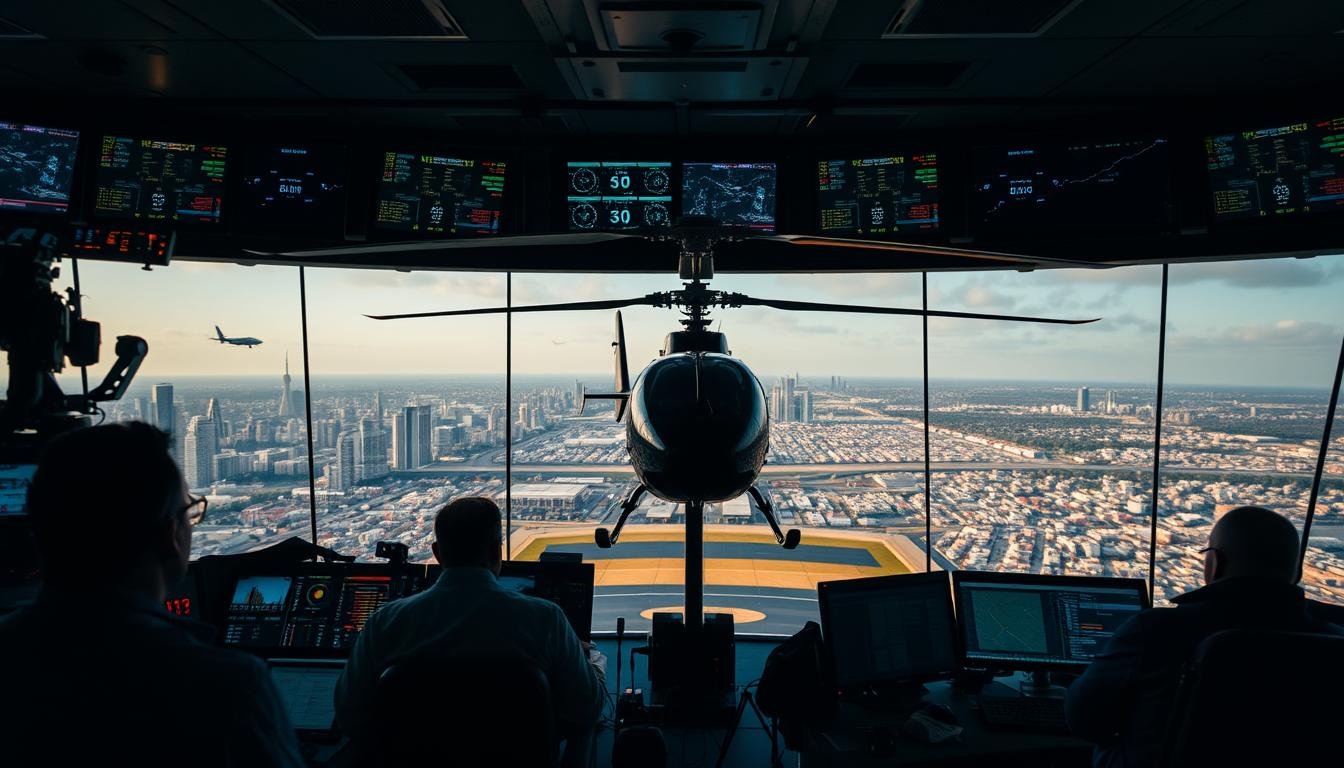
Nearly 90% of low-altitude rotorcraft incidents were linked to coordination lapses or weather surprises, underscoring the critical role of air traffic control in helicopter safety for every phase of flight.
The guide opens by explaining how coordinated services prevent midair conflicts and streamline sequencing for rotorcraft operating near structures and terrain.
It outlines practical steps from preflight planning to landing, tying operations to communication, standardized procedures, and national rules that pilots follow in the United States.
The section previews how controllers use radar and radio to enforce separation and issue instructions, and how pilots retain final authority during emergencies.
Readers will see applied examples and links to further reading about how these systems streamline operations and improve outcomes, such as streamlined procedures described by experts at how ATC streamlines flight operations and practical pilot tips at top helicopter safety tips.
Key Takeaways
- Coordinated services reduce collision risk and keep rotorcraft flows orderly.
- Clear radio procedures and surveillance tools improve operational efficiency.
- Pilot judgment remains central; controllers support with timely information.
- Weather and infrastructure frequently shape routing and delays.
- U.S. standards and procedures guide safe operations near busy airspace.
Air Traffic Control In Helicopter Safety: What It Means And Why It Matters
A coordinated system of surveillance and radio guidance helps pilots manage complex approaches and close-proximity routes.
Air traffic control is a unified set of services for aircraft that combines radar, communications, and procedures to reduce collisions and keep flows orderly. It defines how different airspace classes assign authority and separation standards.
Defining The System, Airspace Classes, And Flight Profiles
ATC serves controlled and advisory areas, tailoring instructions to flight type and the kind of airspace. ICAO and national civil aviation organization rules require standard phraseology; English is available on request.
The Primary Purpose: Collision Prevention, Flow Management, And Information Support
Controllers prevent collisions by enforcing separation and sequencing. They also give pilots timely weather and routing information to support decisions and keep operations efficient.
“Pilots must follow instructions, but the pilot in command may deviate during emergencies to maintain safety.”
| Unit | Primary Role | Typical Phase |
|---|---|---|
| Airport Tower | Local clearances and runway sequencing | Takeoff, landing, surface |
| TRACON | Terminal sequencing and vectoring | Approach and departure |
| En‑Route Center | En‑route separation over regions | Cruise and transitions |
| Advisory Services | Information and traffic advisories | Uncontrolled or special areas |
Special procedures account for hover, vertical ops, and low routes, so rotorcraft get tailored guidance that balances efficiency and safety. For more on U.S. standards and operational text, see ATC operations and standards.
How To Plan A Safe Helicopter Flight With ATC Support
A thorough preflight workflow integrates forecasts, clearances, and contingency options so crews can adapt quickly. It starts with official briefings and a focused go/no-go decision based on weather conditions and regulatory requirements.

Assessing Weather Conditions And Operational Requirements
Pilots review METARs, TAFs, and NOTAMs to set fuel and alternate requirements. They match aircraft performance to terrain and obstacles to confirm climb, cruise, and landing margins.
Selecting Routes, Altitudes, And Airspace Based On Procedures
Teams choose routes and altitudes that follow published procedures and noise corridors. Clearance delivery typically issues the planned route before taxi; controllers may reroute aircraft to avoid adverse weather and keep separation.
Coordinating With Air Traffic Controllers For Clearances And Advisories
Coordination with clearance delivery and traffic control defines expected routing, altitude blocks, and flow constraints. Pilots brief frequencies, verify equipment, and plan handoffs so information flows smoothly during the flight.
- Plan: Review forecasts, fuel, and alternates per civil aviation rules.
- Route: Map corridors that respect procedures and performance.
- Coordinate: File when required and confirm clearances before taxi.
- Contingency: Prepare reroute and divert options for deteriorating weather.
| Phase | Key Action | Outcome |
|---|---|---|
| Preflight | Weather brief, fuel/alternate planning, file flight plan | Predictable dispatch and compliance with requirements |
| Departure | Obtain route clearance from delivery, confirm climb profile | Aligned routing and efficient flow management |
| En‑route | Request advisories for changing conditions or TFRs | Dynamic reroutes that preserve separation and efficiency |
| Contingency | Execute diversion or hold per ATC guidance | Maintained margins and mission continuity |
Practical planning and clear coordination reduce surprises and keep operations efficient.
How To Communicate With Controllers: Radios, Phraseology, And Protocols
Consistent phraseology and disciplined radio habits reduce misunderstandings between pilots and controllers. Clear language follows ICAO standards and helps teams exchange critical information fast.

Using Standard Aviation English And ICAO‑Compliant Phraseology
Pilots should use plain, ICAO‑approved English when requested. Short, structured transmissions cut ambiguity and speed decision making.
Keep calls brief, state the call sign, key data, and end with intent. This pattern supports accurate readbacks and easier monitoring by others on frequency.
Clearance Delivery, Ground, And Tower: Who To Call And When
Contact clearance delivery before taxi to receive route clearances and filed routing. Ground handles movement areas and taxi instructions.
Tower provides takeoff, landing, and local sequencing. Anticipate handoffs and tune the next frequency early to preserve situational awareness.
Traffic Advisories, Instructions, And Readbacks For Pilots
Pilots must read back critical instructions: altitudes, headings, and clearance limits. A full readback confirms mutual understanding.
Request clarification for nonstandard instructions and report deviations during emergencies as soon as practicable.
- Speak steadily: prioritize call sign, clearance, and intent.
- Use standard call signs: avoid clipped or informal IDs.
- Acknowledge advisories: accept or request repeats when background noise or congestion impairs comprehension.
“The pilot in command may deviate from instructions during an emergency, but should notify controllers as soon as practicable.”
For practical phraseology guidance and sample exchanges, see the new pilots guide to ATC communication.
How To Operate In Busy Terminal Areas And Class B Airspace
Operating near busy terminals requires strict sequencing and clear handoffs so all users remain predictable and manageable. TRACON units integrate arrivals and departures, sequencing aircraft and coordinating with tower to protect separation while keeping throughput steady.

Separation Standards, TRACON Procedures, And Local Control
TRACON manages approach and departure flows around larger airports. Separation minimums here are tighter than en‑route standards, so adherence to published procedures matters.
After periods of intense activity, vigilance can lapse. Teams should follow checklist items, confirm clearances, and accept tactical advisories from controllers to reduce error risk.
Helicopter-Specific Considerations: Hovering, Low Altitude, And Congested Routes
Low-speed operations and vertical transitions need predictable routing so faster aircraft can be sequenced around them. Pilots should request altitudes and corridors that reduce conflicts with fixed‑wing flows.
- Follow assigned speeds and altitude blocks to remain visible and manageable in Class B.
- Use standardized hover and transition techniques that preserve obstacle clearance and noise abatement.
- Plan escape routes and alternates for sudden changes in runway configuration or flow.
| Phase | Expectation | Outcome |
|---|---|---|
| Arrival | Sequenced via TRACON, integrate with SIDs/STARs | Predictable merges with fixed‑wing traffic |
| Local | Comply with tower clearances near runways | Maintained spacing and runway access |
| Transition | Request corridors/altitudes to minimize conflicts | Reduced risk during low‑altitude routing |
Checklist Tip: Brief routing, frequencies, escape options, and expected clearances before entering busy areas. Proactive communications with traffic controllers yield timely advisories that improve both efficiency and safety.
How To Leverage Technology And Systems For Safety And Efficiency
Advances in surveillance, navigation, and decision aids let controllers and crews work with clearer position data. This reduces unnecessary vectoring and holds while preserving predictable paths for rotorcraft.

Radar, ADS‑B/ADS‑C, And Surveillance Coverage For Helicopter Flights
Primary and secondary radar remain core tools, and ADS‑B extends visibility where installed. ADS‑C supplements surveillance over oceanic routes through contract reports.
Navigation, Route Guidance, And Use Of IFR Routes For Rotorcraft
Published IFR routes and performance‑based navigation reduce ambiguity when ceilings drop. Pilots use certified equipment and updated databases to meet route standards.
Decision Support Tools And NextGen Initiatives In The United States
Decision aids like TMA and pFAST help centers manage demand and capacity. NextGen upgrades modernize CNS/ATM systems for better data sharing across facilities.
“Equipage and proper database currency let controllers assign the most efficient paths.”
- Verify avionics and navigation databases before dispatch.
- Announce capabilities (for example ADS‑B Out) so optimal routing can be assigned.
- Keep software current to align with national modernization efforts.
| System | Benefit | Pilot Action |
|---|---|---|
| Primary/Secondary Radar | Baseline surveillance near terminals | Monitor transponder and radios |
| ADS‑B | Accurate position broadcasts, better tactical control | Confirm ADS‑B Out status and squawk |
| ADS‑C | Contract reports for oceanic/remote areas | File appropriate contracts when required |
| Decision Support (TMA, pFAST) | Reduces vectoring and delays | Comply with assigned flow and readbacks |
How To Manage Weather, Traffic, And Infrastructure Constraints
Strong coordination between operations teams and controllers lets crews reroute quickly when conditions shift.
Pilots and dispatchers should use live feeds and concise protocols to spot threats early. This approach cuts delays and keeps missions feasible.
Mitigating Weather Impacts With Real-Time Information And Rerouting
Monitor weather sources continuously and set clear trigger points for alternate plans. When convective cells or low ceilings appear, crews must request timely reroutes.
Real‑time information reduces surprise diversions and supports efficient decision making. CANSO data showed weather drove a marked rise in delays, prompting wider use of dynamic routing.
Reducing Congestion Risks Through Procedures And Efficient Traffic Control
Use preferred routes and published procedures that were designed to deconflict flows. Early coordination helps avoid saturated sectors and limits tactical vectoring.
Modernization programs such as NextGen and SESAR improved throughput where implemented, but staffing gaps still affect capacity. Efficient exchanges with controllers can save fuel by reducing holds and indirect routing by an estimated 5–10%.

| Challenge | Mitigation | Outcome |
|---|---|---|
| Rapid weather change | Real‑time feeds, trigger points, planned alternates | Fewer unscheduled diversions |
| Sector congestion | Use preferred routes, early coordination, flow procedures | Reduced holds and delays |
| Infrastructure limits | Announce capabilities, request optimal routing, document lessons | Improved predictability and future planning |
| Staffing shortfalls | Proactive filings and flexible timelines | Lower tactical workload and smoother operations |
“Document lessons learned after weather events to refine procedures and improve outcomes.”
Case-Based Safety: Lessons From U.S. Hotspot Airports
Case studies at major U.S. airports show how targeted procedures and rapid interventions cut close-call rates for mixed operations.
Mixed Traffic Risks Near Major Airports And Class B Compliance
Reviews found that unclear route definitions and missing advisories let mixed fleets converge near Class B boundaries.
Maintaining clear route segments and consistent advisories preserved separation and made operations more predictable for pilots and controllers.
FAA Actions In Las Vegas And Washington, D.C.: Positive Control And Advisories
After a midair near Washington National, the FAA limited non‑essential rotorcraft flights and removed mixed fixed‑wing segments from critical corridors.
At Harry Reid International, adding positive control and targeted advisories reduced proximity events by 30% within three weeks.
Improving Safety Around Closely Spaced Airports In Southern California
Closely spaced fields like Burbank and Van Nuys are under study to refine lateral and vertical routes for diverse fleets.
Operators who share lessons and document compliance help traffic controllers tune procedures that cut risk across the terminal area.
- Request advisories early and confirm assigned route segments.
- Monitor transition altitudes and report deviations promptly.
- Participate in local reviews to improve published standards and procedures.
| Hotspot | Issue Found | FAA Action |
|---|---|---|
| Washington National | Mixed fixed‑wing/rotorcraft corridors after collision | Restricted non‑essential flights; removed mixed segments |
| Harry Reid (Las Vegas) | Advisory gaps, Class B compliance lapses | Positive control + advisories; 30% fewer proximity events |
| Burbank / Van Nuys | Closely spaced paths with diverse fleet types | Ongoing flow analysis and procedural refinements |
How To Train Pilots And Controllers For Helicopter Operations
A formal curriculum that blends simulation, procedure practice, and debriefing yields measurable improvements for crews. Structured programs align pilot and facility expectations so teams act predictably during high workload events.
Communication Protocols And Simulator Use In Rotorcraft Training
Practical modules teach standard phraseology, readbacks, and coordinated handoffs. Instructors stage high-density scenarios to test radio discipline and decision flow.
Simulators recreate weather changes, equipment failures, and complex routing so pilots can rehearse responses without risk. Controllers practice sequencing and issuing clearances under realistic load.
Standardization, SMS Practices, And Continuous Proficiency
Training ties SMS to daily habits: hazard reporting, trend monitoring, and recurrent checks. Consistent inspector training and industry outreach ensure shared interpretation of standards.
- Emphasize communication drills and checklist verification before each sortie.
- Use simulator sessions to rehearse contingencies and refine procedures.
- Promote debriefs, peer review, and attendance at FAA‑industry forums for ongoing learning.
Expanded IFR routes and wider weather camera coverage support training goals by improving route planning and real‑time information. Standardized programs produced measurable gains: fewer deviations, faster readbacks, and stronger coordination among pilots, controllers, and operations teams.
How To Prepare For Emergencies And Abnormal Situations
Prepared crews act faster and make fewer errors. The pilot in command has legal authority to deviate from instructions when required to preserve life and maintain aircraft integrity. Notification to air traffic control should follow as soon as practicable.
Pilot-In-Command Authority, Deviations, And Immediate ATC Coordination
Declare the emergency clearly. State the type, current conditions, souls on board, and remaining fuel so controllers can prioritize response.
Request vectors, altitude blocks, or direct routing as needed. Controllers will work to clear nearby traffic and coordinate sectors to give space for a safe recovery.
| Action | Controller Role | Pilot Expectation |
|---|---|---|
| Emergency Declaration | Prioritize handling and alert relevant sectors | State nature, souls on board, and fuel |
| Request For Vector/Altitude | Provide headings or blocks and coordinate adjacent units | Accept or read back critical instructions |
| Comms Failure / Lost Instruments | Use radar advisories and procedural separation | Follow published lost‑comms procedures and land as required |
Under stress, keep transmissions short and exact. Read back altitude and heading instructions when given; if unable, say so immediately to avoid ambiguity. After the event, file required reports and document lessons so operations teams can refine procedures.
Pre-brief alternates and diversion plans to lower cognitive load during an emergency. Maintain priorities: aviate, navigate, communicate. For further reading on practical challenges, see challenges faced by pilots in emergency.
Conclusion
In closing, the narrative shows how standards, tools, and teamwork produce steadier flows and fewer close calls.
Air traffic control and well‑trained crews share one mission: prevent collisions and keep flights efficient. Modern systems like ADS‑B and NextGen help controllers sequence aircraft and manage changing weather conditions.
Consistent procedures, clear communication, and up‑to‑date navigation and equipment reduce risk. FAA initiatives and civil aviation organization guidance further align operations across facilities and operators.
Continued training, data use, and collaborative review of hotspot events will sustain measurable gains — fewer proximity events, more predictable flows, and resilient operations for all aircraft types.
FAQ
What role does air traffic control play in helicopter operations near busy airports?
Controllers coordinate aircraft movement to prevent collisions, manage flow, and provide pilots with timely information about other flights, surface conditions, and restrictions. They issue clearances and advisories that help pilots navigate complex terminal areas and comply with Class B and TRACON procedures.
How should a pilot plan a rotorcraft flight with ATC support?
The pilot assesses weather, performance limits, and regulatory requirements, selects routes and altitudes consistent with published procedures, files an appropriate flight plan, and requests clearances. Early coordination with controllers and reviewing NOTAMs and current surveillance coverage improves safety and efficiency.
What radio phraseology should helicopter crews use when contacting controllers?
Crews employ Standard Aviation English and ICAO- or FAA-compliant phraseology. They state aircraft identification, position, request or readback, and intentions clearly. Proper readbacks of clearances and immediate clarification of ambiguous instructions reduce misunderstandings.
When should a pilot contact clearance delivery, ground, or tower?
Pilots contact clearance delivery to obtain IFR clearances or route filings prior to taxi. Ground is contacted for taxi instructions and movement on the airport surface. Tower handles takeoff, landing, and traffic sequencing within the controlled zone. At each stage, pilots follow the facility’s frequency and instructions.
How do controllers provide separation for low‑level rotorcraft operations?
Separation standards adapt to helicopter performance and maneuverability. Controllers use procedural separation, radar vectoring, and visual traffic advisories. In constrained airspace, they may assign specific altitudes, routes, or hold points to maintain safe spacing from other aircraft.
What technologies improve situational awareness for rotorcraft and controllers?
Surveillance systems such as secondary radar and ADS-B enhance detection. Navigation aids, GPS-based route guidance, and flight management tools support precise routing. Decision support and NextGen programs in the United States further integrate data to optimize sequencing and reroutes.
How are weather impacts managed during a short‑notice diversion or reroute?
Pilots obtain real‑time weather updates from ATC and automated sources, evaluate alternate landing sites, and request amended clearances or vectors. Controllers assist with traffic reallocation and provide traffic advisories while coordinating airspace constraints to enable safe deviations.
What special considerations apply when operating near major U.S. hotspot airports?
Mixed‑mode operations, dense flight paths, and adjacent airport complexing increase risk. Operators must comply with Class B requirements, follow local procedures, and heed FAA advisories. Enhanced surveillance and positive control measures often apply in places like Las Vegas and Washington, D.C.
How can training reduce communication errors between pilots and controllers?
Joint simulator sessions, standardized phraseology drills, and continuous proficiency checks build mutual expectations. Emphasis on concise transmissions, proper readbacks, and scenario‑based exercises improves coordination and lowers the chance of misinterpretation.
What actions should a pilot take during an in‑flight emergency requiring deviation from ATC clearances?
The pilot exercises pilot‑in‑command authority to ensure safety, immediately inform ATC of the emergency and intentions, and accept vectors or priority handling. Controllers provide assistance, coordinate airspace changes, and clear other traffic to facilitate a safe outcome.
How do operators and regulators improve efficiency while maintaining safety?
They implement procedures that reduce congestion, adopt surveillance and navigation upgrades, and apply data‑driven traffic management strategies. Ongoing collaboration between FAA, airlines, and rotorcraft operators fosters operational improvements without compromising safety.oviding navigation assistance, weather updates, emergency support, and coordination for safe flight operations. Whether flying in controlled or uncontrolled airspace, helicopters rely on ATC to help them avoid collisions, navigate through complex airspace, and respond to emergencies. By working closely with ATC, helicopter pilots can ensure safer and more efficient flight operations, regardless of the challenges they face in the air.
Related Articles
- How to Avoid Common Helicopter Pilot Errors: A Guide to Safe Flying
- The Role of Air Traffic Control in Helicopter Safety
- Helicopter Safety in Bad Weather: Tips for Flying in Adverse Conditions
- How to Safely Land a Helicopter in Challenging Conditions
- The Importance of Proper Helicopter Maintenance for Flight Safety
More from This Category
- Understanding Helicopter Weight and Balance: Why It’s Crucial for Safe Flying
- Emergency Procedures in Helicopter Flights: How to Handle In-Flight Incidents
- Helicopter Pre-Flight Inspections: What Pilots Must Check Before Takeoff
- How to Prepare for Your First Helicopter Ride: Safety Procedures for Passengers
- Top 10 Helicopter Safety Tips Every Pilot Should Know