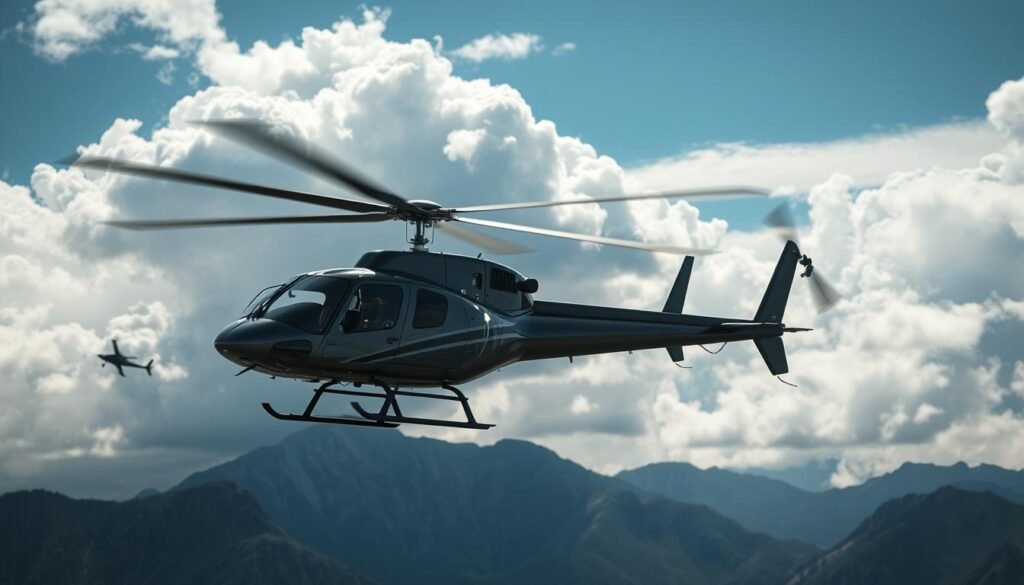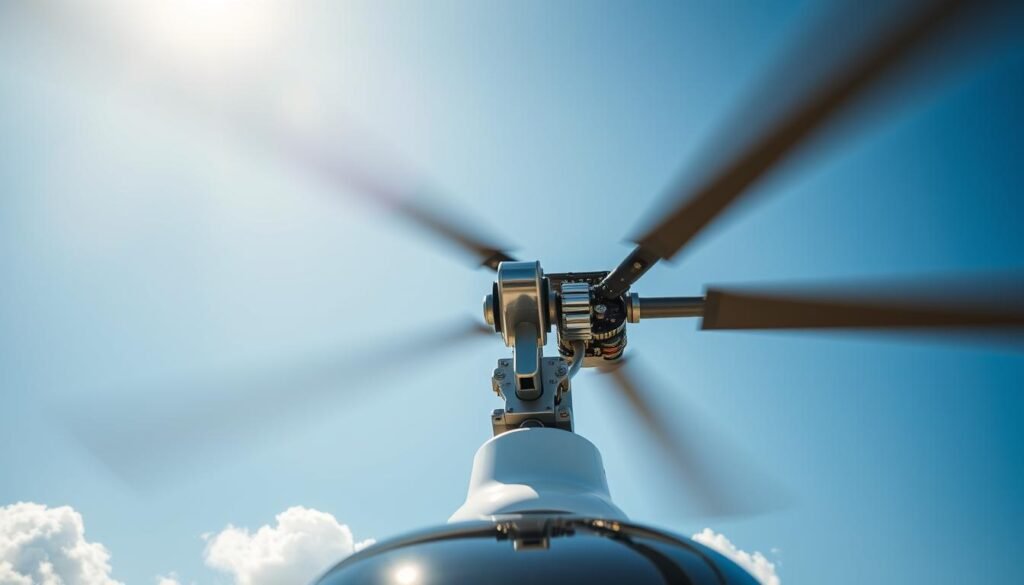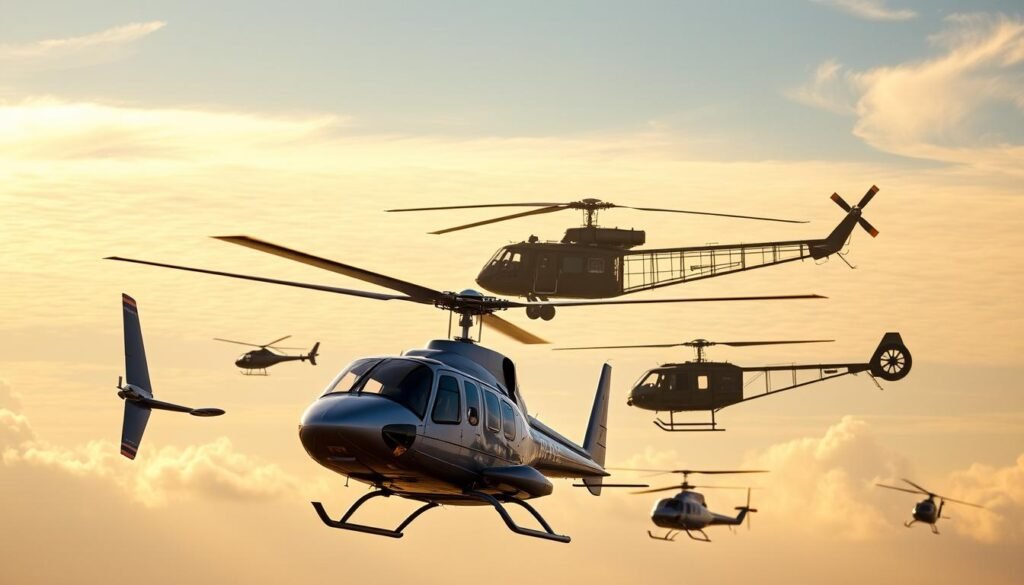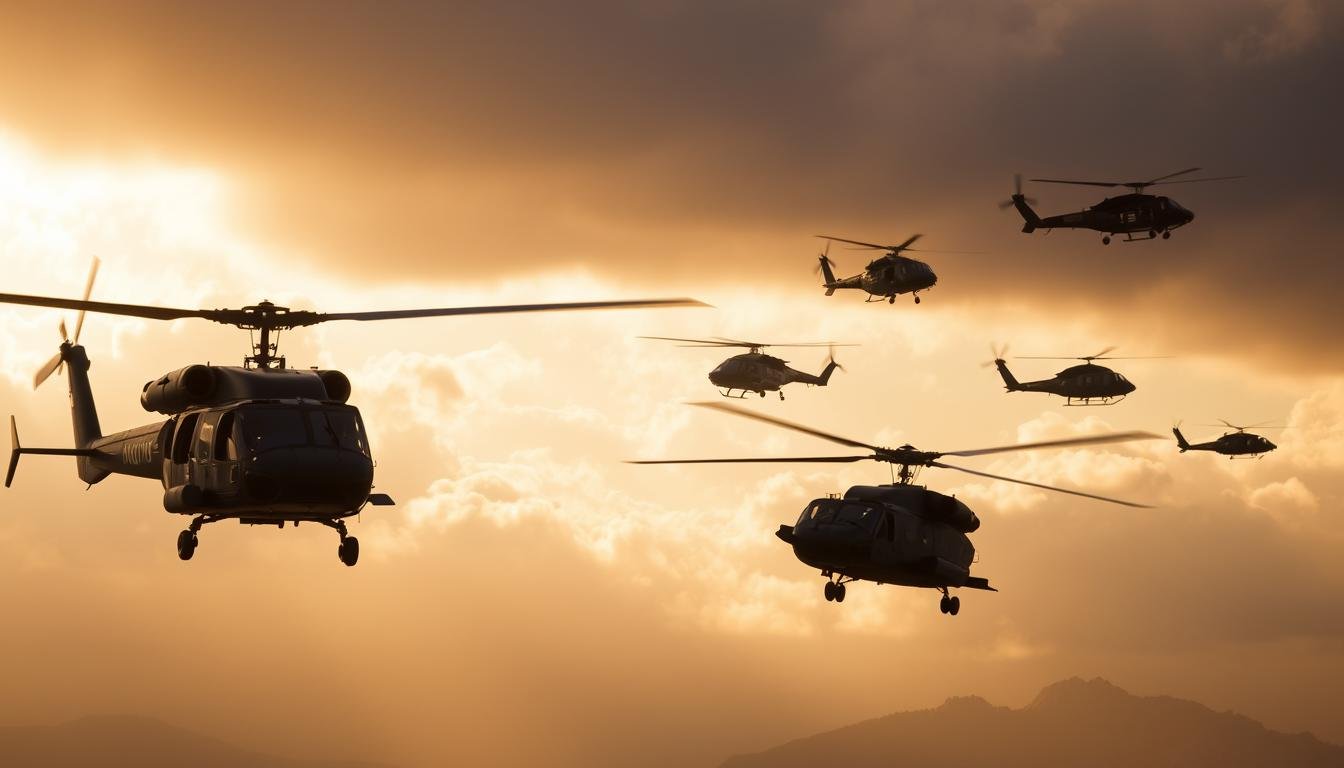
Have you ever wondered about famous helicopters in history—like the Huey, the Black Hawk, and other iconic models that reshaped aviation? These aircraft account for millions of flight hours and tens of thousands of airframes, tracing their legacy back to rotary‑wing breakthroughs after 1942, when practical helicopters began transforming the skies. Readers will discover why certain models became icons: their durable roles, widespread use across military and civil operations, and high‑visibility missions that entered public life.
This guide moves from the first functional designs to heavy‑lift and special operations craft, blending concise data points—first flights, production totals, top speeds, and notable records—with stories of MEDEVAC missions, search and rescue operations, and broadcast reporting from the air. A dedicated link to the Huey profile provides further detail on one landmark type: the Bell UH‑1 Iroquois.
Key Takeaways
- Early rotorcraft set technical and cultural benchmarks across the world.
- Production milestones, like the Huey and Black Hawk, cemented public recognition.
- Iconic models served both military and civilian missions for decades.
- Data-driven details (flight dates, speeds, payloads) anchor each profile.
- The article follows a clear progression from prototypes to specialized models.
Famous Helicopters In History: What Makes A Helicopter Iconic
Recognition follows aircraft that keep performing under pressure and show up when the world needs them most. Iconic models combine design reliability with missions that capture public attention.
Operational Firsts, Records, And Service Longevity
Operational firsts—like early combat rescues or first civilian certification—often start an aircraft’s rise. Long front-line service proves adaptability and builds trust across militaries and agencies.
- Records for speed, altitude, or payload attract headlines and technical respect.
- Repeat deployments, from MEDEVAC to heavy lift, cement a model’s reputation for service.
Media Portrayal, Special Missions, And Global Use
News coverage and films turn technical platforms into cultural symbols. Special missions—search and rescue, disaster relief, and covert operations—make aircraft visible and memorable worldwide.
Case examples include Chinook disaster relief and Black Hawk special operations. For broader context, see a list of the most important rotorcraft and quick facts at top helicopter facts.
Pioneers Of Vertical Flight: From First Helicopter To Mass Production
Prototype trials in the 1930s and early 1940s answered core questions about lift, control, and reliability. Engineers tested rotor concepts and control systems until designs proved suitable for broader use.
Focke-Wulf Fw-61: The First Functional Helicopter And Autogyro Roots
The Focke-Wulf Fw-61 made its first flight on June 26, 1936. Henrich Focke drew on Cierva autogyro work to fit twin articulated rotors on outriggers. Hanna Reitsch’s 1938 indoor display at Deutschlandhalle showed remarkable stability and cyclic control.

Sikorsky R-4: Single Main Rotor, Tail Rotor, And The First Mass-Produced Helicopter
Igor Sikorsky’s R-4 flew on January 14, 1942 and set the pattern of a single lifting main rotor with a vertical tail rotor. The U.S. Army accepted the type in 1942. Early records included a 761-mile cross-country and a 12,000 ft service ceiling.
- Operational milestones: first deck landing (1944) and the first combat rescue (YR-4B, 1944).
- Legacy: lessons on rotor dynamics and tail control enabled mass production and military training pipelines that followed.
Civilian Game-Changers: Certification, News, And Everyday Flight
Civil aviation took a major step when light rotorcraft moved from military labs to city rooftops and farms. Certification and steady performance opened doors for private operators, broadcasters, and utility services.

Bell 47: First Certified For Civilian Use, Records, And TV “Telecopter” News
The Bell 47 flew on December 8, 1945 and earned CAA approval in 1946. More than 5,600 were produced, with over 1,000 still airworthy today.
Roles ranged from pilot training and crop spraying to lunar lander simulations. KTLA’s 1958 “Telecopter” showed how airborne news changed urban reporting.
Bell 206 JetRanger: Observation Helicopter Turned Civilian Icon
The 206 began as the YOH-4A prototype and the redesigned 206A first flew in 1966. By 1973 sales topped 1,000 and overall production exceeded 7,300 units.
Military adoption as the OH-58A and TH-57A helped the JetRanger prove low operating costs, solid mph cruise, and reliable service. A 206L made a noted around-the-world flight in 29 days, adding to its endurance record.
- Civil certification milestones: opened markets for training, EMS, and charter — see a detailed timeline at civil certification milestones.
Bell UH-1 Iroquois “Huey”: The Vietnam Legend That Changed Warfare
When the first UH-1 took flight, commanders began to plan operations around vertical lift. The model moved from prototype selection to frontline service fast and changed how forces operated during combat.
Main Rotor “Whump-Whump,” Air Assault Tactics, And MEDEVAC

The two-blade main rotor made a distinct whump-whump signature that became synonymous with MEDEVAC runs and troop insertions. Air assault doctrine matured as units used this aircraft to move squads quickly under fire.
From Prototype To Production: How The HU-1 Became The Huey
Selected from 20 designs in 1955, the HU-1 first flew on October 20, 1956. It was the first U.S. military turbine-powered helicopter and soon proved its worth across roles.
Over 16,000 built, the design adapted to gunship, utility, and medical roles. Production lineage continues with modern variants such as the UH-1Y and Bell 412.
| First Flight | Selected | Built | Primary Roles |
|---|---|---|---|
| Oct 20, 1956 | 1955 (from 20 designs) | 16,000+ | MEDEVAC, troop transport, gunship, utility |
| Engine Type | Rotor | Legacy | Impact |
| Turbine | Main rotor (two-blade) | Continued lineage | Redefined air mobility and rescue |
The UH-1 Iroquois remains a reference point when assessing later aircraft and doctrines. Its years of service proved that a simple, reliable airframe can reshape warfare and save lives.
Boeing CH-47 Chinook And Mil Mi-26: Heavy-Lift Titans Of The Skies
Two heavy-lift designs redefined what rotary-wing aircraft could haul and where they could go.

CH-47 Tandem Main Rotors, No Tail Rotor, And 196 Mph Speed
The CH-47 first flew on September 21, 1961. It uses twin, counter-rotating 60 ft rotors and so needs no tail rotor.
Powered by twin Lycoming turboshafts, the Chinook reaches a top speed of 196 mph, making it one of the fastest heavy-lift aircraft. Vietnam service saw it move artillery and slingloads under combat conditions.
Mi-26: Largest Series Production Helicopter And Record Lift Capability
The Mi-26 flew on December 14, 1977. Its eight-blade, 105 ft main rotor and two Lotarev D-136 turbines produce 22,800 shp.
It carries internal loads up to 44,000 lbs and set a record lift of 125,153.8 lbs to 2,000 m in 1982. The Mi-26 also performed high-profile recoveries, including a U.S. MH-47E in Afghanistan.
Disaster Relief, Oil, And Outsize Cargo Across The World
Heavy-lift machines are vital for disaster response and industry support. Both types have flown relief missions after tsunamis, earthquakes, and industrial accidents.
Design contrasts—tandem versus single main rotor—show different solutions to torque and payload challenges. Oil and gas operators use these aircraft to move equipment to remote platforms across many countries.
| Type | First Flight | Rotor | Payload/Record | Key Roles |
|---|---|---|---|---|
| CH-47 Chinook | Sep 21, 1961 | Dual 60 ft tandem, counter-rotating (no tail rotor) | Fastest heavy-lift ~196 mph; large external slingloads | Troop lift, artillery, disaster relief |
| Mil Mi-26 | Dec 14, 1977 | Eight-blade 105 ft main rotor | Internal 44,000 lbs; record 125,153.8 lbs to 2,000 m | Outsize cargo, firefighting, recovery missions |
Mil Mi-8 “Hip”: The World’s Most Produced Helicopter
The Mil Mi-8 rose from Soviet design bureaus to become a global workhorse for transport and support.

The type first achieved flight on July 7, 1961 and entered rapid production by 1967. Over 17,000 were built, making the Mi-8 the most numerous rotary machine on the planet.
It carries 24 troops or 12 stretchers and uses twin Isotov TV2 turbines of roughly 1,500 shp each with a new gearbox. More than 35 variants, including the Mi-17, expand its roles from transport and gunship to civilian heavy lift.
Wide adoption followed. The Mi-8 serves with about 80 countries and stays useful after decades of upgrades.
- Durability: simple maintenance and rugged systems supported long service years.
- Versatility: troop movement, medevac, cargo, and disaster response, notably at Chernobyl.
- Value: balanced payload, range, and cost made the aircraft a default regional choice.
| First Flight | Built | Typical Load |
|---|---|---|
| July 7, 1961 | 17,000+ | 24 troops / 12 stretchers |
| Engines | Countries | Notable Roles |
| Twin Isotov TV2 (~1,500 shp each) | ~80 | Transport, gunship, civilian lift, disaster response |
Bell AH-1 Cobra: The First Dedicated Attack Helicopter
Developed from Bell’s D-255 Iroquois Warrior concept, the AH-1 Cobra first flew on September 7, 1965.
The design used a narrow fuselage, tandem seating, and stub wings to focus the airframe on weapons delivery and low-observable profiles. It borrowed core UH-1 parts—main rotor, engine, transmission, tail boom/empennage, and tail rotor—to speed development and simplify logistics.
The Cobra debuted operationally during the Tet Offensive of 1968. It performed escorts, hunter/killer team missions paired with an observation helicopter, and rescue support under fire.
Key advantages included reduced weight and drag compared with troop transports, stub wings for varied ordnance, and a responsive rotor system that gave agility at low altitude.
- The AH-1 set the template for purpose-built attack aircraft and shaped modern armed reconnaissance.
- Vietnam operations validated the concept and influenced global doctrine.
- The airframe evolved into the AH-1Z Viper, showing adaptability to new sensors and weapons.
Sikorsky H-60 Black Hawk: The Modern Huey For Special Forces And Beyond
The H-60 family arrived from the UTTAS program as a durable, upgradeable platform. Its first flight was October 17, 1974 and the design won the Army’s UTTAS contest as the YUH-60A.
UTTAS Origins, T700 Engines, And Seahawk Family Expansion
The H-60’s twin T700 engines gave reliable power and better survivability. The Navy adopted the SH-60B Seahawk in 1978 while Army models entered service in 1979.
Variants include the Jayhawk (USCG), Pave Hawk, and VH-60N. More than 4,000 produced, the family shares common parts and upgrades to lower life-cycle costs.
Search And Rescue, MEDEVAC, And Global Service Records
The aircraft’s main rotor and airframe balance lift, speed, and payload for assault, logistics, and search rescue missions.
- Proven MEDEVAC and humanitarian use around the world.
- High-profile special operations flights shaped its reputation for elite missions.
- Ongoing avionics and drivetrain technology upgrades keep the H-60 relevant.
“The Sikorsky heritage, tied to Igor Sikorsky’s pioneering work, lives on in modern H-60 variants.”
Bottom line: The black hawk remains a backbone aircraft for many services, valued for mission flexibility, global support networks, and a clear upgrade path.
Light, Low-Cost, And Ubiquitous: Robinson R-22 And The GA Revolution
Small, affordable rotorcraft opened a new chapter for private and training aviation.
The Robinson R-22 first flight occurred in the year 1975 and it earned FAA certification in 1979. The two-seat, piston-powered design used a 150 hp Lycoming O-320 and a low-inertia rotor. By 2015 nearly 5,000 units had been produced and the model made private rotary access far more affordable.
Training, Ranch Work, And Operating Cost Advantages
Operational value: The R-22 reduced purchase and hourly costs, so many flight schools adopted it for primary training and autorotation practice.
The light, two-seat layout also proved ideal for surveying and cattle management. Towable on a trailer, it simplified storage and transport for rural operators.
- Simple systems and a reliable piston engine kept maintenance low and hours affordable.
- Its compact footprint made operations from small helipads practical and efficient.
- The R-22’s success spawned larger family models, reinforcing Robinson’s place in general aviation.
Speed, Agility, And Aerobatics: Westland Lynx And Eurocopter X3
High-speed rotorcraft pushed designers to rethink lift, torque, and cruise performance.
The Westland Lynx first flew on March 21, 1971 and earned a reputation for remarkable agility. It performed full aerobatic maneuvers—loops and rolls—thanks to an advanced main rotor and a stiff airframe.
Early speed development set a record of 199.9 mph in 1972. Continuous upgrades led to 249 mph by 1986. Roles included transport, armed escort, and anti-ship missions, with service in the Falklands and Iraq.
Westland Lynx: Fully Aerobatic Helicopter And Early Speed Records
The Lynx showed how rotor design could deliver both agility and rapid dash performance. Test teams focused on vibration reduction and blade control to expand safe flight envelopes.
Eurocopter X3: Hybrid Prop-Rotor Concept And World’s Fastest “Helicopter”
The Eurocopter X3 first flew on September 6, 2010 and married a lift rotor with wing-mounted propellers. At 10,000 ft it reached 255 knots (293 mph) in 2013, illustrating how propulsive thrust complements rotor lift.
Main Rotor Torque Management, Stub Wings, And High-Speed Development
Torque management and rotor blade design are central to safe high-speed flight. Stub wings add lift and allow propellers to provide cruise thrust while the rotor handles vertical access.
- The Lynx proved extreme agility for tactical missions and search rescue profiles.
- The X3 demonstrated near-300 mph cruise for offshore and shuttle concepts.
- Flight test programs validated stub-wing and prop combinations for future development.
Autonomy And Tiltrotor Frontiers: MQ-8 Fire Scout And V-22 Osprey
Sea-based unmanned systems and hybrid wing-rotor craft opened fresh operational options. Both pathways changed how forces observe and move across theater air space.
MQ-8: First Operational Autonomous Helicopter For Naval ISR
The MQ-8 Fire Scout, based on the Schweizer 330, had its first flight in 2002. Early RQ-8A prototypes met goals of 125 NM, three hours, and 200 lb payload.
Operational impact: It proved persistent ISR at sea, launched from frigates and cutters, and delivered 24-hour coverage across multi-sortie operations by 2012.
V-22 Osprey: Tiltrotor Speed, Range, And Expeditionary Use
The Bell/Boeing V-22 merged helicopter VTOL with turboprop cruise speeds. After a long development cycle starting in 1983, the Osprey showed greater speed, range, and payload than many conventional types.
Technology advances such as triple-redundant fly-by-wire and transition control enabled expeditionary missions from austere sites despite early program groundings.
| Platform | First Flight / Development | Key Strength | Roles |
|---|---|---|---|
| MQ-8 Fire Scout | 2002 / Schweizer 330-based | Persistent unmanned ISR | Shipboard observation, surveillance |
| V-22 Osprey | First flight after long development (post-1983) | Speed & range; VTOL+cruise | Expeditionary lift, special ops, logistics |
“Autonomy and tiltrotor designs expanded the mission space and informed future models across services.”
Conclusion
From early test beds to high-speed demonstrators, certain aircraft set new expectations for what vertical lift could do. Across aviation and long service years, the Fw-61’s 1936 spectacle and later milestones show steady progress. The UH-1 Iroquois exceeded 16,000 built and the Black Hawk family passed 4,000, while the Bell 206 and R-22 broadened access and training.
Practical records—Chinook speed, Mi-26 lift, JetRanger sales—prove that diverse models answer different needs. These aircraft served rescue, combat, industry, and media roles and shaped outcomes on the ground.
Over time, upgrades and new concepts keep helicopters relevant. Their stories link engineering to human impact under real skies and across the world, ensuring this chapter of history still informs future design.
FAQ
What made the Bell UH-1 Iroquois “Huey” so influential in combat?
The Huey introduced practical air assault and rapid MEDEVAC during the Vietnam War. Its single main rotor and tail rotor design offered reliability and simplicity. High production numbers, troop transport capability, and proven battlefield adaptability cemented its role as a model for later military utility helicopters like the Black Hawk and many international designs.
Which aircraft is considered the first functional helicopter and why does the Focke-Wulf Fw 61 matter?
The Focke-Wulf Fw 61 (1930s) is widely regarded as the first practical, controllable rotary-wing aircraft. It demonstrated sustained, controlled vertical flight and inspired autogyro and rotorcraft development. Its successful flights validated the rotor configuration that later evolved into single main-rotor/tail-rotor layouts used by pioneers such as Igor Sikorsky.
How did the Sikorsky R-4 change rotorcraft production?
The Sikorsky R-4 became the first mass-produced helicopter during World War II, popularizing the single main rotor and tail rotor arrangement. It proved useful for observation, rescue, and liaison roles, establishing manufacturing practices and operational doctrines that shaped postwar civil and military helicopter development.
Why is the Bell 47 historically important for civilian aviation and media?
The Bell 47 was the first helicopter certified for civilian use in the United States. Its bubble canopy, stability, and versatility made it ideal for observation, crop dusting, and news reporting as the “telecopter.” The Bell 47 set early endurance and speed marks for light rotorcraft and helped open markets for private and commercial helicopter services.
What role did the Bell 206 JetRanger play in observation and civilian operations?
The Bell 206 JetRanger combined cost-effective operation, reliable turbine power, and good visibility, making it a standard for law enforcement, media, corporate transport, and emergency services. Its long production run and international use made it one of the most recognizable light turbine helicopters worldwide.
How do tandem-rotor designs like the CH-47 Chinook differ from single-rotor types?
Tandem-rotor helicopters such as the Boeing CH-47 Chinook use two large counter-rotating rotors fore and aft. This eliminates the need for a tail rotor, increases lift capacity, and improves center-of-gravity flexibility for heavy cargo. The Chinook achieved high cruise speeds for a heavy-lift craft and excelled in transport and disaster-relief missions.
What makes the Mil Mi-26 notable among heavy-lift aircraft?
The Mil Mi-26 is the largest series-production helicopter, with record-setting payload capability. Designed for outsized cargo, it supports disaster relief, oilfield logistics, and military lift operations where moving very heavy or large items is required. Its sheer lift capacity sets it apart from most rotorcraft.
Why is the Mil Mi-8 often called the world’s most produced helicopter?
The Mil Mi-8 (NATO: “Hip”) combined straightforward construction, multi-role flexibility, and exportability. Produced in vast numbers, it served transport, search-and-rescue, medevac, and armed gunship duties across many countries, earning a reputation for robustness and ease of maintenance.
What distinguished the Bell AH-1 Cobra as a dedicated attack helicopter?
The AH-1 Cobra was the first U.S. helicopter built specifically for attack roles. Its slim profile, tandem cockpit, and focused weapons systems provided better survivability and lethality than modified utility types. The Cobra influenced later attack designs and tactics for rotorcraft close support.
How did the Sikorsky H-60/Black Hawk family evolve from the Huey concept?
The Black Hawk emerged from the U.S. UTTAS program to replace older utility types like the Huey. With T700 turbine engines, improved avionics, and airframe advances, the H-60 family expanded into search-and-rescue, naval (Seahawk), and special operations roles. It balanced speed, survivability, and payload for global military service.
Why are light helicopters such as the Robinson R-22 important for general aviation?
The Robinson R-22 lowered acquisition and operating costs for pilot training, aerial work, and private use. Its two-seat layout, simple systems, and economical fuel consumption expanded access to rotorcraft flying and supported growth in flight schools and small utility operations.
What achievements highlight the Westland Lynx and the Eurocopter X3 in speed and agility?
The Westland Lynx set early rotorcraft speed records and demonstrated exceptional maneuverability, even carrying out aerobatic maneuvers. The Eurocopter X3 used a hybrid prop-rotor layout with stub wings and propellers to reach unprecedented high speeds for a helicopter, showcasing advanced torque management and high-speed development concepts.
How are tiltrotors and unmanned rotorcraft changing mission profiles?
Tiltrotors like the V-22 Osprey combine helicopter vertical lift with airplane cruise speed and range, enabling fast expeditionary and assault missions. Autonomous systems such as the Northrop Grumman MQ-8 Fire Scout provide naval ISR and persistent surveillance without onboard pilots, expanding operational options for navies and special units.
What advancements improved helicopter safety and performance over decades?
Engine reliability, composite rotors, active vibration control, advanced avionics, and fly-by-wire systems improved safety and handling. Better maintenance practices, standardized certification, and mission-specific variants for SAR, medevac, and attack roles also enhanced operational effectiveness across civil and military fleets.
How does rotorcraft design manage main rotor torque and tail rotor requirements?
Single main-rotor helicopters use a tail rotor to counteract torque and provide yaw control. Tandem and coaxial layouts cancel torque through counter-rotating rotors, eliminating the need for a conventional tail rotor. Designers balance efficiency, control responsiveness, and mechanical complexity when choosing configurations.
Which models set notable service and production records worldwide?
The Mil Mi-8 and Bell UH-1 achieved exceptionally high production and service lifespans. The CH-47 and Mi-26 set heavy-lift performance benchmarks. The Bell 206 and Robinson R-22 dominated civilian production runs in their classes, while Sikorsky’s R-4, H-60 family, and the AH-1 left lasting legacies in military service.