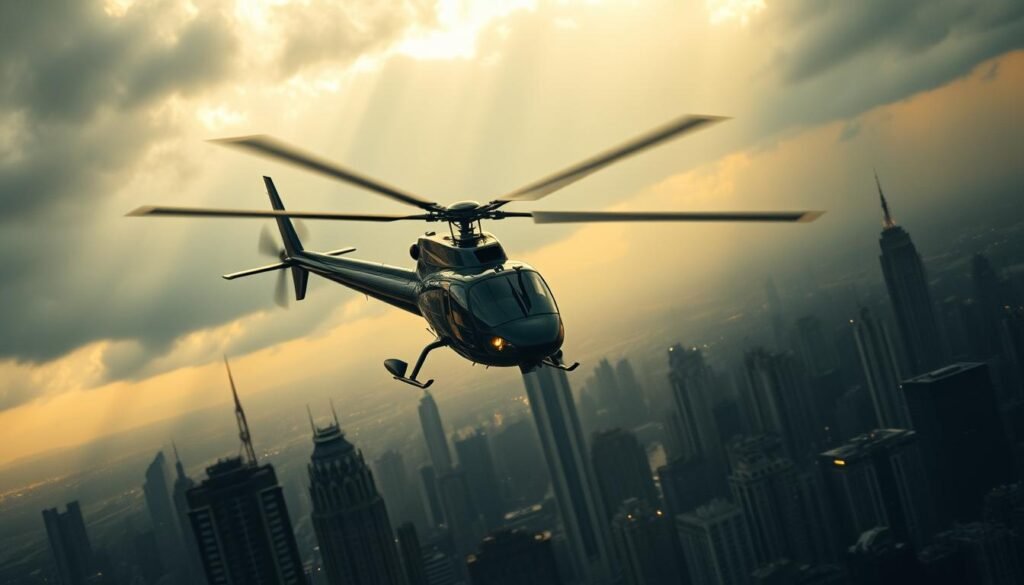
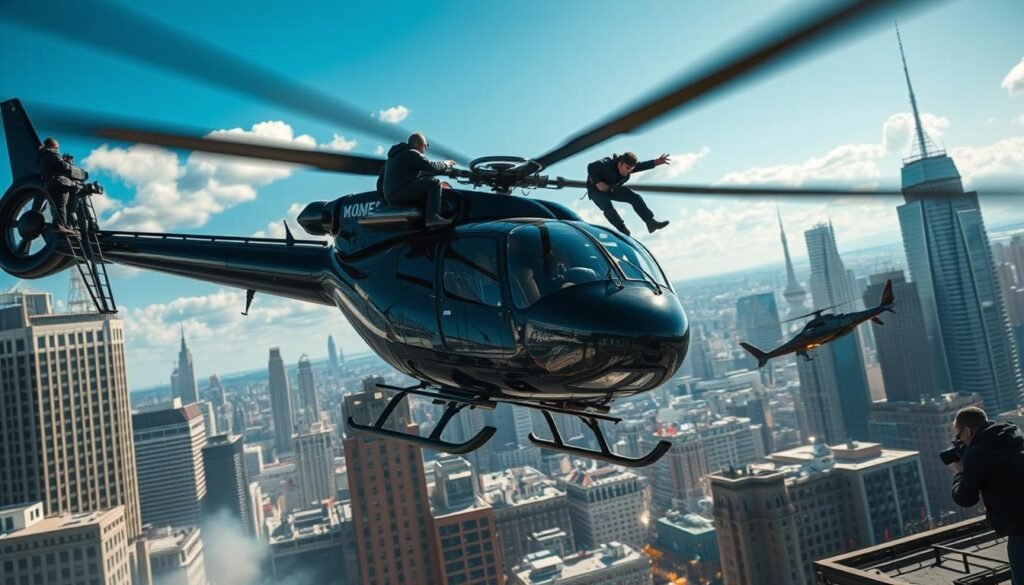
“Cinema is a matter of what’s in the frame and what’s out.” —Orson Welles. This idea fits perfectly when blades and rotors redraw the frame and raise the stakes—especially with helicopters in movies.
Helicopters in Movies have long punched above their weight, turning transport into spectacle. Directors use a single craft to signal scale, danger, or a sudden burst of air that changes a scene’s mood.
From the shock of wartime strafes to glossy sci‑fi rescues, each film finds a fresh spin on aerial peril. Viewers remember the roar, the prop wash, and the clever stunts that make those moments stick.
Expect a compact list that traces how filmmakers choreograph geography, physics, and timing to keep the audience oriented while chaos unfolds. For a guided tour of iconic set pieces and the craft behind them, see this curated roundup of top scenes and moments.
Key Takeaways
- Rotors became cinematic shorthand for immediate danger and scale.
- Directors blend practical stunts with VFX to sell airborne tension.
- War films and thrillers use cockpit close-ups to add character beats.
- Franchise escalation pushed set pieces larger and more inventive.
- The list highlights craft: timing, choreography, and editorial rhythm.
- Explore detailed examples and scene breakdowns at this collection of iconic moments.
Top helicopter movie scenes offers the examples that inspired this overview.
Helicopters in Movies: Iconic Moments That Shaped The Big-Screen Chopper
A single rotor can flip a quiet street into a cinematic battleground with one well-timed swoop. Filmmakers have used that sudden shift to create set pieces that viewers never forget.
From War Zones To Window Smashes: Why Helicopters Steal The Scene
Iconic doesn’t always mean biggest. Clarity and a bold idea make a sequence stick.
Live Free Or Die Hard turns a tunnel into an escalating puzzle where John McClane launches a car at a hovering chopper. Blue Thunder stages a citywide duel that ends with a train hitting a rotor. The Dark Knight rigs a cable across streets and sends a police craft into a building.
The List Maker’s Dream: How Films Turn Blades, Tunnels, And Skyscrapers Into Set Pieces
- Mission: Impossible ties a winch line to a train for a breathless finale.
- 28 Weeks Later uses blades as a brutal ground weapon.
- Battleship stacks mass destruction into one airfield spectacle.
| Film | Set Piece | Key Idea |
|---|---|---|
| Live Free Or Die Hard | Tunnel car vs. chopper | Readable geography, punchline payoff |
| Blue Thunder | Skyscraper duel | City as chessboard |
| The Dark Knight | Cable trap | Urban architecture as weapon |
For a closer look at these iconic helicopter scenes, see this iconic helicopter scenes roundup and this must-watch helicopter movies list.
Futuristic Designs And Sci-Fi Spectacle: Choppers Levitating Beyond Logic
Helicopter set pieces push a film’s rules until the audience happily accepts the lie.
The tunnel, the airfield, and the ruined street become laboratories where a chopper can do the impossible.

“Mission: Impossible” Tunnel Showdown: Winch Lines, Chewing Gum, And A Train
Mission: Impossible locks a rotor into a steel throat—the winch line tethers a chopper to a Eurostar while a detonated patch of explosive gum shatters a windshield.
The scene sells terror with tiny details: a skid grab, a near‑miss rotor blade, and a train that turns a stunt into a deadline.
“Battleship” Airfield Gauntlet: An Octuplet Of Exploding Helicopters For Pure Spectacle
At an air base, alien tech slices through parked craft and eight choppers go up in sequence.
The count is obvious and gleefully maximalist: the spectacle trades subtlety for raw, relentless impact.
Post‑Apocalyptic Mayhem: “28 Weeks Later” Turns Rotor Blades Into A Zombie Thresher
A pilot angles the nose low so the blades become a savage tool, cutting through a surge of infected.
That choice turns rotor physics into gruesome problem‑solving when bullets and time run out.
Inventive Destruction Playbook: EMPs, Alien Tech, And Aerodynamically Impossible Maneuvers
Broken Arrow introduced EMP takedowns; Blue Thunder bends flight for drama. Together they form a grammar of cinematic destruction.
- Gadget Logic: Precise triggers and cockpit inserts make a cheat feel earned.
- Readable Geography: Tunnels, windows, and cars give viewers a kinetic map to follow.
- Payoff Over Physics: If the camera explains the lie, the audience forgives it.
For a broader look at how aircraft are portrayed on screen, see this aircraft in fiction overview and this piece on how choppers changed action.
Action, Police, And War: The Practical Side Of Movie Helicopter Mayhem
helicopter set pieces often trade flashy trickery for clean, tactical staging that an audience can follow.
On-screen air assaults trade pure spectacle for tactical choreography and readable stakes.

“Live Free Or Die Hard” Tunnel Escape: Out Of Bullets, Into A Car‑Launched Chopper
McClane turns a cramped tunnel into a practical kill switch. Traffic reroutes, a car becomes a projectile, and the payoff lands on a quip: “I was out of bullets.”
“Rambo III” Fire And Fury: Mounted Gun Vs. Soviet Air Power
Rambo III stacks variety: a machine‑gunned chopper, a crash landing, an explosive arrow, and a tank vs. aircraft coda. The film embraces excess as a design choice.
“Blue Thunder” Over Los Angeles: Cat‑And‑Mouse Above The Skyline
Blue Thunder treats the city as a three‑dimensional chessboard. Low passes between towers and a train‑ram finale keep the viewer oriented while the tension climbs.
“Apocalypse Now” Ride Of The Valkyries: Napalm, Air Cavalry, And Cinematic History
The air cavalry sequence pairs Wagner with napalm, making the scene both a sensory assault and a landmark of war cinema.
“The Dark Knight” Cable Trap: Gotham’s Police Chopper Meets Joker’s Chaos
Urban planning becomes a weapon: cables between buildings snare a police craft and punctuate a larger ambush.
“True Lies” Human Rocket: A Propelled Villain Meets A Doomed Helicopter
True Lies opts for comic‑book brutality. A villain turned rocket brings a surprisingly inventive downing that reads like a practical gag with stakes.
Exploding Helicopter Hall Of Fame: “Broken Arrow,” “Sudden Death,” “Stone Cold,” And “The Last Match”
These films form a compact list of favorite destruction beats: gunfire, collisions, window launches, and even a grenade‑stuffed football. Each sequence finds a single, readable idea and runs with it.
- Why it works: Clear geography, a single stunt idea, and precise editing make the danger feel earned.
- Common tools: cars, tunnels, buildings, cables, and inventive pilot work.
Conclusion
helicopter moments keep returning because they do work both loud and small.
From a Eurostar tether to eight airfield fireballs, from Wagner‑scored raids to cable snags and car‑launched takedowns, the canon spans grit and gloss.
The best film setups treat machines as characters. They design geography so audiences read the stakes, tease the payoff, then deliver a sequence that feels earned.
That mix—practical stunt craft, careful VFX, and ruthless momentum—lets chopper scenes stay fresh over time.
In short: define the space, escalate with purpose, then finish with a payoff that both surprises and feels inevitable. For a compact look at classic destruction beats, see this roundup of exploding craft.
Top exploding helicopter films
FAQ
Why do filmmakers keep using choppers for dramatic scenes?
Directors love them because they combine motion, height, and sound into instant spectacle. A rotorcraft can hover outside a window, roar over a city, or drop a rope team, giving filmmakers a visual shorthand for danger, rescue, or power that cars and trains can’t match.
Are those futuristic flying designs physically possible?
Many on-screen craft borrow real aeronautical ideas but exaggerate them. Tiltrotors and VTOL concepts are real, but levitating, silent craft with impossible maneuverability belong to science fiction. Engineers often call them “dramatic license,” not engineering specs.
Which films set the benchmark for helicopter action?
Several stand out: Vietnam-era air cavalry sequences, daring tunnel chases, and cable-trap confrontations pushed the genre. Each movie picked a stunt—boundary-pushing maneuvers, large-scale explosions, or inventive use of a chopper—that others tried to top.
How do productions film dangerous rotorcraft stunts safely?
They combine experienced pilots, precision planning, stunt doubles, and safety rigs. Remote-controlled models, CGI, and carefully choreographed practical effects help get the shot while protecting crew and actors. Insurance and aviation authorities set strict rules.
Can a car really launch into a helicopter like in some action sequences?
Real physics makes that unlikely without heavy modification. Movies often use ramps, cables, or clever editing to sell the moment. Practical effects teams build safe rigs and use visual effects to bridge the plausibility gap.
Why do war films keep returning to rotorcraft imagery?
Rotorcraft symbolize rapid deployment and air mobility. In combat cinema, they represent urgency, tactical advantage, and the chaotic contrast between quiet ground and thunderous air support—making them perfect for dramatic storytelling.
How realistic are onboard gun fights and explosions shown in action movies?
Filmmakers heighten danger for impact. Mounted weapons exist and have been used historically, but enclosed cabin firefights and close-range explosions are typically staged with safeguards, blank-firing weapons, and CGI to avoid real harm.
Do movie choppers ever use EMPs or alien tech as plot devices? Are those plausible?
EMPs and alien gadgets are popular shorthand for sudden system failure. While electromagnetic pulses can disrupt electronics, the sweeping, instantaneous effects shown onscreen are dramatized. Alien tech, of course, is pure invention for spectacle.
What role does CGI play versus practical effects in modern rotorcraft scenes?
CGI fills gaps that are unsafe or impossible to film practically—distant overhead shots, catastrophic destruction, or fantastical maneuvers. Practical effects still anchor scenes with tactile realism: real aircraft, stunts, and foreground crashes paired with digital enhancement.
Are there environmental or legal limits to filming large aerial set pieces?
Yes. Filmmakers must obtain flight permits, follow airspace restrictions, and consider noise and wildlife impacts. Local aviation authorities and environmental laws influence what can be filmed and where, often dictating time, height, and safety measures.
How do audiences react to recurring chopper tropes like tunnel chases and rooftop rescues?
Viewers tend to cheer the bold moments when they’re executed well. Iconic set pieces become shorthand for excitement; fresh staging or a clever twist keeps them engaging, while lazy repeats can feel tired. Innovation keeps the trope alive.
Where can someone learn more about the real aircraft used in films?
Aviation museums, pilot forums, and documentary features on film stunts are good places to start. Many productions list aircraft models in credits or press kits, and aviation magazines often profile how specific models were modified for the screen.tinue to inspire filmmakers and captivate audiences.
Related Articles
- The Most Expensive Helicopters in Film Productions
- Helicopter Pilots as Heroes: Celebrating On-Screen Aviation Heroes
- Behind the Scenes: How Helicopter Stunts Are Filmed in Blockbusters
- Helicopters and Superheroes: From Rescue Missions to Epic Battles
- Realism vs. Fiction: How Helicopters Are Portrayed in Movies