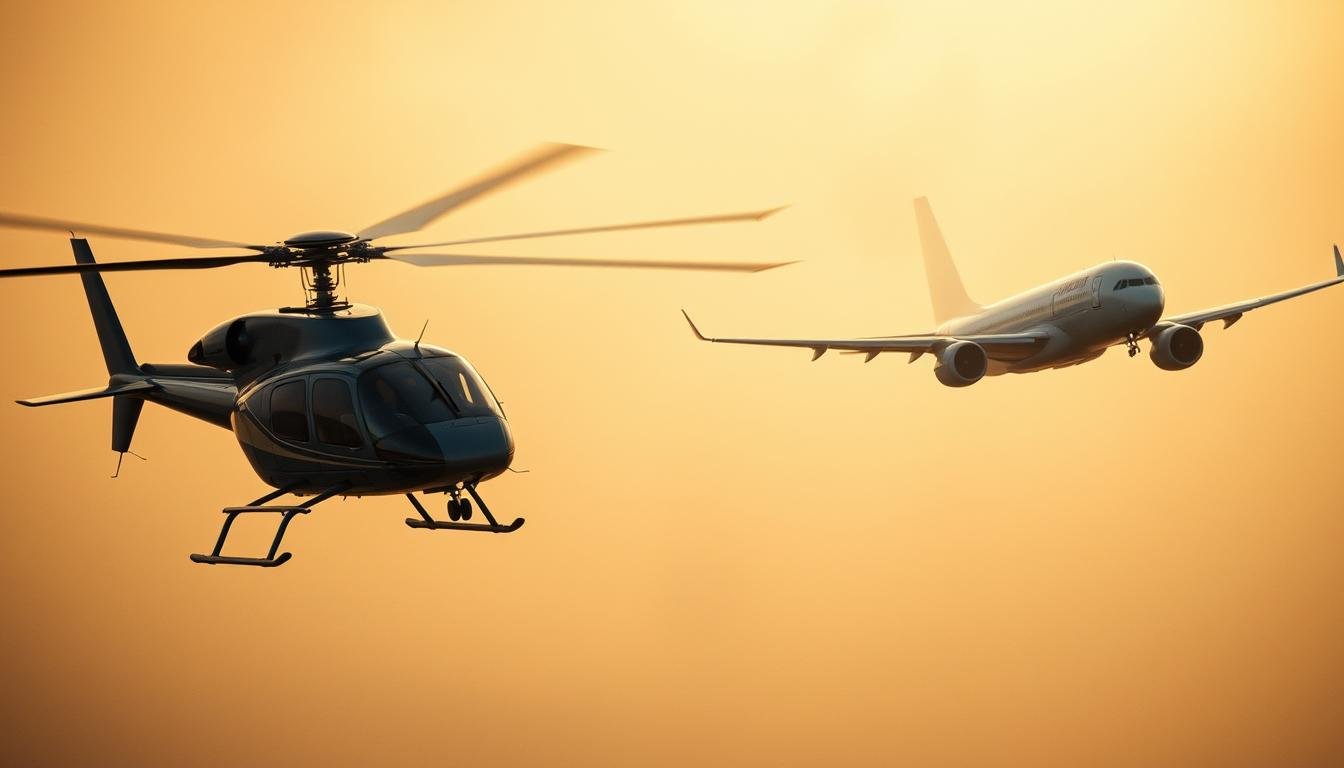
Are helicopters safer than airplanes? From 2019–2023, the U.S. Helicopter Safety Team reported a fatal accident rate of 0.73 per 100,000 flight hours, while smaller private planes recorded about 1.049 in 2020. The numbers challenge public instinct—people often recall dramatic crashes, but raw rates tell a different story. Context matters: mission type, maintenance, and pilot training all shape safety outcomes in aviation today.

Helicopters perform high‑risk jobs like rescue, firefighting, and disaster relief. Many operations expose aircraft to hazards, yet most flights finish without incident thanks to better design, autorotation capability, and modern avionics.
Pilots, procedures, and layered systems such as autopilot, radar, GPS, and traffic advisories all contribute to lower accident counts. This article will compare lift and design, safety metrics, mission types, weather effects, emergency procedures, maintenance, and training to show where each aircraft excels.
Key Takeaways
- Fatal accident rates give a fair basis for comparison, but they depend on mission and aircraft type.
- The U.S. Helicopter Safety Team data shows strong safety performance for rotorcraft in recent years.
- Operational roles like rescue and firefighting increase exposure to risk yet benefit from specialized training.
- Design features such as autorotation and modern avionics improve emergency options and overall safety.
- Interpreting safety requires looking past headlines to maintenance, procedures, and pilot skill.
- The goal is informed comparison, not a blanket declaration of one category as superior.
Understanding The Debate And Search Intent In The United States
U.S. readers often look for practical guidance: how risk compares across mission types and everyday travel choices. Searchers want to know how safety is measured, which operations influence outcomes, and what that means for charter or sightseeing trips.
Helicopter and fixed‑wing operations follow different rules and serve different needs. Rotorcraft handle low‑altitude urban hops, EMS, law enforcement, and news work. Fixed‑wing planes fly fixed routes, carry larger loads, and suit longer trips.
Regulations, training, and standard procedures shape baseline safety. Pilot instruction, recurrent training, and mission profiles influence accident rates more than simple comparisons. Public perception often reflects media‑covered high‑risk missions rather than routine flights.
| Characteristic | Common Helicopter Uses | Common Airplane Uses |
|---|---|---|
| Altitude & Routes | Low altitude, flexible routes | Higher altitude, prescribed routes |
| Typical Missions | EMS, urban transport, news | Charter, scheduled, long‑range cargo |
| Safety Drivers | Pilot training, mission risk | Maintenance, route structure |
Context matters. People should compare similar mission types, pilot experience, and regulatory environments when evaluating safety. Later sections will link these user questions to lift, metrics, missions, weather, emergency procedures, maintenance, and training under U.S. rules.
How Helicopters And Airplanes Generate Lift And Manage Flight
Two families of machines use distinct physics to stay aloft: rotors that spin and wings that slice the air. This difference shapes mission ability, pilot inputs, and how each aircraft handles emergencies and weather.

Rotors, Blades, And Hover: Helicopter Control And Lift
Rotors and blades spin to accelerate air downward, producing lift without runway needs. That lets a helicopter hover, pivot, or translate laterally for precise placement in tight spots.
Controls work continuously: collective changes total lift, the cyclic tilts the rotor disc to move, and anti‑torque pedals manage tail thrust. Pilots use coordinated inputs to hold attitude near terrain and obstacles.
Fixed Wings, Forward Motion, And Cruise: Airplane Aerodynamics
Fixed wings need forward airspeed to create lift. Sustained motion gives efficient cruise, higher true airspeeds, and better fuel economy on long trips at altitude.
Design priorities differ. Rotorcraft favor maneuverability and stationkeeping in the sky. Airplanes emphasize aerodynamic efficiency, speed, and range for long distances.
- Hover ability enables EMS pickups, aerial crane work, and utility inspections.
- Winged cruise reduces pilot workload on long flights and improves comfort.
- Weather and density altitude affect rotor margins and wing lift in different ways.
Understanding lift and controls helps explain why emergency options, approach profiles, and pilot technique vary. Pilots adapt continuously: rotor pilots make fine, constant inputs while many fixed‑wing pilots monitor stable cruise regimes. For those moving between types, see transition tips for pilots at transition from fixed‑wing to rotorcraft tips.
Defining Safety: What Accident Rates Really Measure
Normalizing fatal outcomes by hours flown gives a clearer comparison across varied aviation work. The fatal accident rate reports fatalities per 100,000 flight hours. It helps compare different aircraft and mission sets on a common base.

Fatal Accident Rate Per 100,000 Flight Hours
The metric shows how many people die for every 100,000 hours flown. It reduces bias from fleet size or trip counts. Yet it has limits: it does not reflect mission difficulty, terrain, or frequency of takeoffs and landings.
General Aviation Versus Commercial Operations
General aviation covers private and on‑demand work. Commercial airlines follow tighter routes and larger crews. Comparing these groups directly can mislead readers without matching mission types.
| Category | Typical Exposure | Why Rates Differ |
|---|---|---|
| On‑demand Utility | Many low‑altitude ops and landings | More takeoffs, variable terrain, higher exposure |
| General Aviation Training | High cycle flights for students | Frequent handling errors and low experience levels |
| Scheduled Airlines | Long cruise, fixed routes | Strict oversight, redundancy, lower fatality rates |
| Helicopter Airborne Work | Rescue, EMS, aerial work | Specialized training, autorotation capability affects outcomes |
Federal Aviation Administration rules, certification, and recurrent training shape safety by setting maintenance and operational standards. Data collection methods and operator culture also change measured rates. Readers should view rates as one part of a wider safety picture that blends design, oversight, and human factors.
Are Helicopters Safer Than Airplanes: What Recent U.S. Data Shows
Recent U.S. data offers a measured view of relative risk across rotorcraft and fixed‑wing fleets. Comparing rates requires matching mission types, time windows, and hours flown.
U.S. Helicopter Safety Team Findings (2019-2023)
The U.S. Helicopter Safety Team reported a fatal accident rate of 0.73 per 100,000 flight hours for 2019–2023. That figure reflects many mission profiles and shows strong safety gains when operators follow standards.
Fixed-Wing General Aviation Comparisons And Context
Smaller private planes recorded about 1.049 fatal accidents per 100,000 flight hours in 2020. FAA commentary in 2020 noted a helicopter sector five‑year moving average near 0.63 versus overall general aviation at ~0.94.
Commercial Airliner Safety Benchmarks
Commercial jetliners show far lower risk by another measure — roughly one death per 2.7 million flights. That benchmark uses different aircraft, oversight, and operations.
- Context Matters: hours flight time, operator class, and mission type change comparisons.
- Exposure: EMS, search rescue missions, and firefighting often face adverse weather conditions and complex terrain.
- Risk Reduction: pilot training, maintenance, and cockpit tech (autopilots, TAWS/ADS‑B, radar, GPS) have cut accidents over time.
Summary: Recent U.S. helicopter safety performance looks strong, but answering which platform is preferable depends on matched datasets and mission context. Readers should weigh local operator practices and aircraft equipment when assessing specific flights.
Operations And Risk Exposure: Missions, Environments, And Use Cases
Missions shape exposure: low‑level work and rooftop pickups change the risk profile in clear ways.
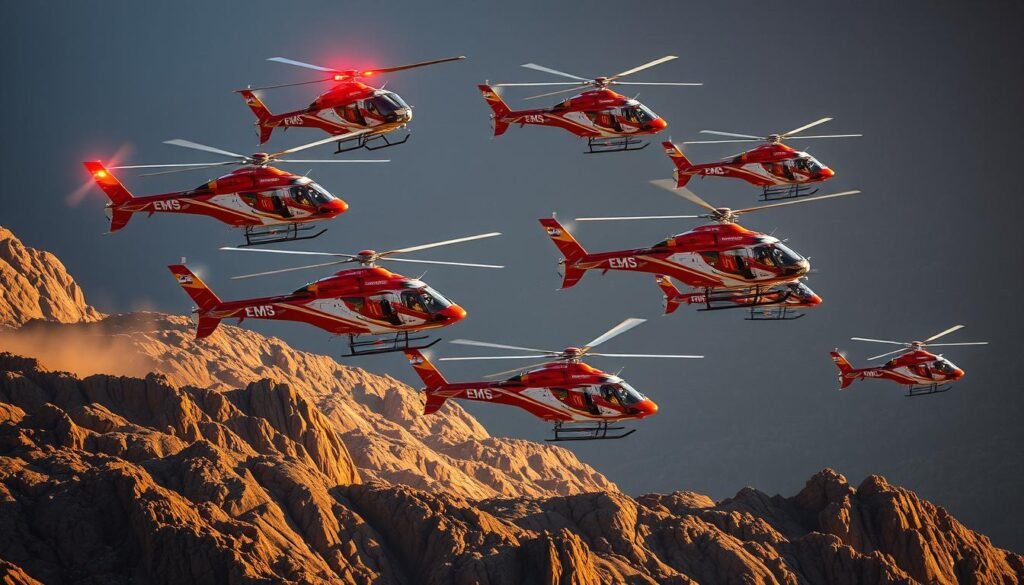
Search and rescue missions, EMS, and firefighting operations rely on vertical lift and hover ability to reach casualties and hazards close to the ground. This capability makes the helicopter ideal for time‑critical transports and confined‑area landing.
Search And Rescue Missions, EMS, And Firefighting Operations
Rescue missions often occur in difficult skies — smoke, terrain, and shifting weather. Crews follow strict checklists and crew resource management to limit exposure.
Mission equipment such as NVGs and enhanced vision extends safe windows when crews are trained and authorized. See common emergency operations challenges for operational context.
Charter, Sightseeing Flights, And Urban Air Mobility
Charter and sightseeing operations use rooftop access and city‑center pads to reduce door‑to‑door time. Flexible routing and panoramic views add value for passengers.
Operating discipline and policy adherence remain central to safety in busy urban corridors.
Longer Trips, Higher Altitudes, And Airline Routes
Fixed‑wing operations excel at higher cruise altitudes, longer ranges, and fuel efficiency for scheduled routes. Those strengths lower workload during cruise but shift risk to terminal procedures and longer decision times.
“Operations define exposure: low‑level maneuvering increases pilot workload, while high‑altitude cruise emphasizes systems redundancy and procedure.”
| Use Case | Typical Environment | Operational Advantage |
|---|---|---|
| EMS / Search Rescue | Low altitude, confined sites | Hover, vertical landing, rapid pickup |
| Firefighting | Smoke, uneven terrain | Precision drops, access to remote fires |
| Charter / Sightseeing | Urban corridors, rooftops | City access, reduced door‑to‑door time |
| Airline / Cargo Routes | High altitude, controlled airways | Greater range, efficiency, redundancy |
- Close‑to‑ground work supports lifesaving outcomes but increases exposure.
- Flight planning, communications, and checklists reduce risk in both operations.
- Operator experience and equipment tune the mission to match needs and environment.
Weather, Technology, And Training: Managing Adverse Conditions
In low visibility, systems and skill combine to keep missions within safe margins. Modern rotorcraft integrate autopilot and computer‑assisted controls that stabilize flight and cut pilot workload during instrument work and complex VFR tasks.

Autopilot, Computer-Assisted Controls, And Stability Aids
Autopilots and stability augmentation give envelope protection and free pilot attention for decisions. That helps during long instrument approaches or when wind and turbulence increase workload.
Radar, Lidar, GPS, And Traffic Advisory Systems
Sensor suites—radar, lidar, and cameras—extend see‑and‑avoid in rain, fog, or low light. GPS navigation, radio altimeters, and traffic advisories give precise vertical and lateral references for low‑level approach segments.
Pilot Training For Low Visibility And Adverse Weather Conditions
Pilots train in scenario‑based instruction and recurrent drills to manage degraded environments. Checklists, crew resource management, and cross‑checks of tech prevent controlled flight into terrain and loss of control.
- Capability Varies: Properly equipped helicopters can operate in weather that once stopped missions, provided crews are qualified.
- Automation Aids Judgment: Controls assist but do not replace pilot decision making or regulatory limits.
- Policy Matters: High‑reliability operators institutionalize training and procedures to keep safety margins intact.
Emergency Procedures And Design Redundancy
When an engine fails, built‑in design and practiced technique often determine whether a flight ends safely.
Emergency planning combines aircraft design, pilot action, and preflight maintenance to create predictable outcomes in critical moments.

Autorotation And Controlled Power‑Off Landings
Autorotation converts altitude and forward speed into rotor energy so the rotor keeps lift without engine power.
Pilots reduce the collective to unload the rotor, manage airspeed, and time a flare to slow descent before touchdown on suitable ground.
“Autorotation gives crews an engineered option for a controlled landing even after propulsion loss.”
Single‑Engine Events, System Redundancy, And Outcomes
Many models include redundant hydraulics, dual electrical buses, and twin‑engine layouts to limit single‑point failures.
Routine maintenance and checklists cut the chance of propulsion events. When failures occur, trained pilots follow steps: recognize the problem, execute memory items, and pick a landing zone.
Rotor inertia, blades design, and aircraft weight shape autorotative performance and the choice of forced‑landing sites.
Conclusion: Engine events are uncommon. Successful results rely on solid design, disciplined pilot execution, and systematic operations—not luck.
Maintenance, Inspection Cycles, And FAA Oversight
A disciplined maintenance program is the backbone that keeps aircraft mission‑ready and reliable.
Part 91 Requirements: The federal aviation administration requires annual inspections for all Part 91 aircraft and 100‑hour inspections when used for hire or instruction. These mandated checks, plus interval checks for specific equipment, create a baseline of oversight that reduces mechanical risk.
Part 91 Requirements: 100‑Hour And Annual Inspections
Operators follow manufacturer guidance, airworthiness directives, and service bulletins to keep conformity. Good recordkeeping and disciplined inspection cycles let teams spot trends before they become failures.
Health Monitoring, Parts Improvements, And Downtime Reduction
Health and usage monitoring systems detect anomalies in real time so maintenance crews can fix issues before a forced landing or unscheduled downtime.
Materials and lubrication advances extend service intervals for both helicopter and airplane components. Technicians with proper tooling and on‑site spares speed turnarounds and preserve mission schedules.
- Regulations set the floor; top operators exceed them with extra checks and QA test flights.
- Post‑maintenance test flights validate work and confirm airworthiness before return to service.
- Robust maintenance and focused training directly support safer outcomes and reliable flight operations.
For a deeper look at system reliability and operator practices, see this review on operational safety system factors and performance.
Training Pathways, Hours Of Flight Time, And Costs
Pilot training paths set the foundation for safety and career progression in vertical and fixed‑wing flight. Basic and advanced certificates require staged instruction, exams, and supervised flight time to meet regulatory minima and build judgment.
Private And Commercial Licenses: Helicopter Versus Airplane
In the U.S., a Private Pilot License requires a minimum of 40 hours of flight time in both helicopter and airplane categories. A Commercial License typically needs about 150 hours for helicopter candidates and roughly 250 hours for airplane candidates.
Representative costs vary widely: PPL helicopter training often runs $24,000–$30,000+, while PPL airplane commonly costs $15,000–$20,000+. CPL helicopter programs can exceed $95,000, versus CPL airplane ranges near $55,000–$100,000.
Instruction, Flight Exams, And Experience Building
Instruction moves from basic maneuvers to emergency procedures. Students complete ground school, knowledge exams, and practical tests supervised by examiners.
Time building and structured syllabi develop decision making across conditions. Recurrent training, scenario‑based checks, and mentorship sustain proficiency over a pilot’s career.
“Logging diverse hours and practicing emergency drills are key to converting training into effective airmanship.”
| Stage | Typical Hours Minimum | Representative Cost Range (USD) |
|---|---|---|
| PPL (Helicopter) | 40 | $24,000–$30,000+ |
| PPL (Airplane) | 40 | $15,000–$20,000+ |
| CPL (Helicopter) | 150 | $95,000+ |
| CPL (Airplane) | 250 | $55,000–$100,000+ |
Additional ratings—IFR, multi‑engine, and turbine transitions—add hours and cost depending on the types of operations a pilot pursues, such as charter or instruction.
Controls and cockpit automation training improve situational awareness and workload management in both platform classes. Logging varied flight experience across conditions and models broadens judgment for high‑pressure operations.
For pilots considering career options or cross‑training, see the comparison on airplane vs helicopter pilot for practical guidance.
Noise, Altitude, And Approach Profiles Near Airports
Low-altitude flight choices often reflect a trade-off between mission access and community impact. Pilots and operators weigh performance, traffic sequencing, and local rules when planning an approach.
Why Helicopters Fly Lower And Don’t Always Descend Vertically
Helicopter flight near terminals usually happens below the altitudes used by airplanes. Routing flexibility, obstacle clearance, and the need to remain outside controlled airspace drive that pattern.
Despite the ability hover, vertical descents into confined sites are often avoided. Performance limits, wind, and safe energy management favor shallow, stabilized approaches and controlled touchdowns instead of steep drops.
Community Noise, Flight Paths, And Operational Needs
Regulations and local procedures shape where helicopters fly to reduce disruption. Noise‑abatement corridors, published routes, and ATC sequencing help balance community impact with safety.
Pilots follow assigned altitudes that may pass over residential areas depending on runway alignment, helipad location, and traffic flow. Operators adjust power settings and speeds when feasible to reduce noise at the ground.
- Stabilized approaches sometimes resemble airplane traffic patterns to keep predictable spacing with planes and maintain visibility.
- Terrain, obstacles, and weather often make vertical landing impractical or less safe than a shallow profile.
- Urgent missions—medical or law enforcement—can require closer routes to population centers despite higher noise exposure.
“Airport coordination and ATC instructions govern how helicopters and airplanes share the sky, prioritizing separation and predictability.”
Community engagement with airport authorities helps residents learn about local procedures and noise‑abatement programs that guide helicopter operations.
Final Thoughts
Contemporary U.S. data shows fatal accident rates for rotorcraft that compare favorably with general aviation fixed‑wing in similar missions, while commercial operations maintain the lowest risk. This evidence frames safety as a function of hours flown, mission type, and adherence to standards.
Aircraft design, pilot training, and operator discipline—plus sound maintenance—drive outcomes. The helicopter’s ability to hover and access confined sites makes it essential for rescue and utility work. Rotorcraft experience and equipment matter for those missions.
People choosing travel should match needs to the right platform: select helicopters for precision and access, planes for range and capacity. When crews follow procedures and maintain systems, accidents remain rare and the skies stay safe.
FAQ
What does recent U.S. data reveal about helicopter versus airplane safety?
Recent U.S. statistics show that rotorcraft used in emergency services, tourism, and private operations have higher fatal accident rates per 100,000 flight hours than scheduled air carrier operations. The FAA and the Helicopter Safety Team report trends that vary by mission type: emergency medical services and off-airport work carry greater exposure to risk, while well-regulated scheduled airline flights maintain the lowest fatality rates.
How do rotorcraft generate lift compared to fixed-wing aircraft?
Rotorcraft generate lift through rotating blades that produce an upward force and allow vertical takeoff, hover, and multidirectional flight. Fixed-wing aircraft rely on forward motion across wings to create lift and require runways for takeoff and landing. That fundamental difference changes operational profiles and risk exposure in differing environments.
What accident-rate metrics should readers consider when assessing safety?
The most useful metrics include fatal accidents per 100,000 flight hours and accidents per flight hour for specific operation types. Comparing general aviation rotorcraft to commercial airlines without accounting for mission mix, weather exposure, and airport infrastructure gives a misleading picture.
How do mission types affect risk exposure?
Search-and-rescue, EMS, firefighting, and aerial work often occur at low altitude, in marginal weather, and over confined terrain, increasing risk. Sightseeing, charter, and urban air mobility involve frequent takeoffs and landings in congested areas. Airline routes are typically longer, higher, and operate with tighter procedural controls, reducing many operational hazards.
What role does pilot training play in safety outcomes?
Training intensity, currency, and experience directly influence outcomes. Rotorcraft pilots require specific instruction in hovering, confined-area operations, autorotation, and single-engine procedures. Airline pilots complete rigorous type-specific training, recurrent checks, and crew resource management that contribute to lower accident rates.
How do emergency procedures differ between rotorcraft and fixed-wing planes?
Rotorcraft use autorotation to manage power-off scenarios, enabling controlled descent even with engine failure. Fixed-wing aircraft rely on glide performance and forced-landing techniques. Design redundancy, such as multiple engines or backup systems, changes survivability and maneuver options during emergencies.
What technologies reduce risk in both aircraft types?
Autopilot systems, stability augmentation, terrain awareness, GPS navigation, traffic advisory systems, radar, and lidar improve situational awareness and reduce pilot workload. Advanced health monitoring and predictive maintenance also lower mechanical-failure risk for both rotorcraft and fixed-wing fleets.
How does weather influence operational safety?
Low visibility, icing, strong winds, and turbulence increase risk for all aircraft. Rotorcraft often operate closer to terrain and in marginal conditions, so specialized training and equipment for instrument flight, terrain avoidance, and de-icing are essential to manage adverse weather safely.
What maintenance and regulatory practices matter most?
Regular inspections, strict adherence to FAA maintenance schedules, and effective health-monitoring systems reduce in-flight failures. Part 91 operations still require annual inspections and, for certain uses, 100-hour checks. Robust oversight and manufacturer service bulletins improve fleet safety when followed diligently.
How do costs and required flight hours compare for rotorcraft and fixed-wing licenses?
Rotorcraft training often costs more per hour and demands specialized instruction for skills like hovering and confined-area work. Commercial and private certificates require different minimum flight hours; building experience for challenging missions can increase training time and expense compared with many fixed-wing pathways.
Why do rotorcraft operate at lower altitudes and different approach profiles near airports?
Rotorcraft fly lower and perform steep or offset approaches to serve helipads, urban rooftops, and unimproved sites. These profiles reduce transit time to scene locations but increase exposure to obstacles, power lines, and noise-sensitive communities, requiring precise pilot technique and community-aware operational planning.
Can improved technology and training make rotorcraft risk comparable to airline operations?
Advances in avionics, automated stability systems, better weather sensors, and enhanced pilot training narrow the gap for many mission types. However, the inherent differences in mission profile and operating environment mean risk levels remain mission-dependent rather than universally equivalent to scheduled airline safety.
Additional Resources: