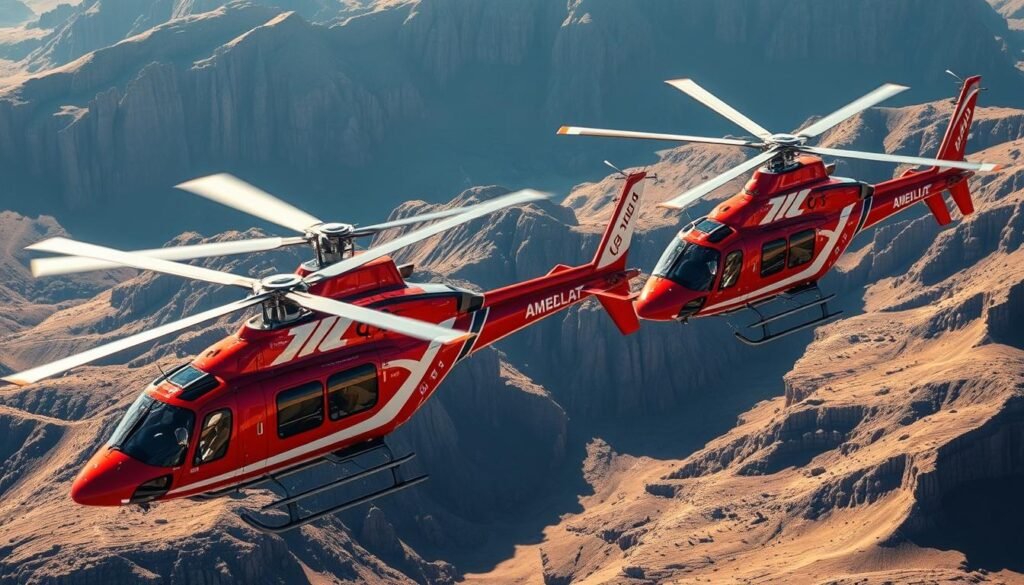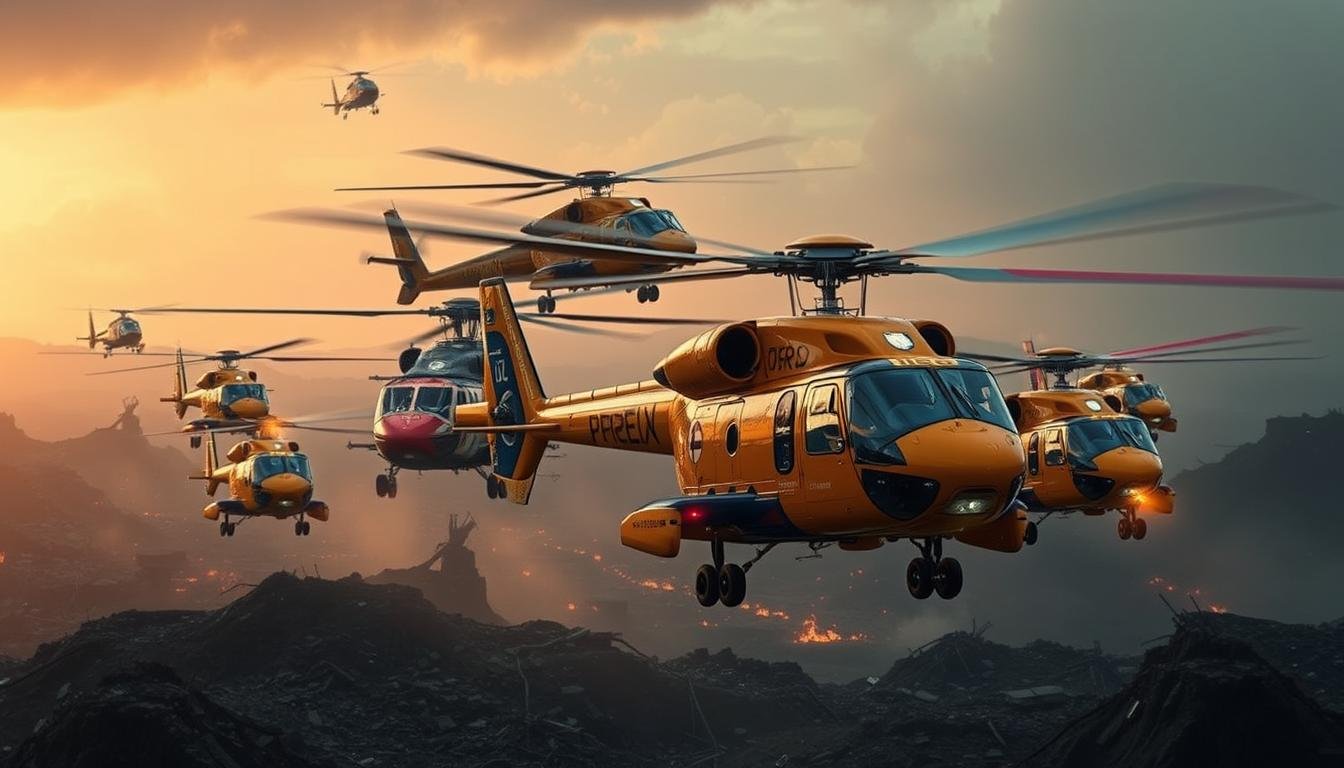
One study found air response teams reached survivors up to four times faster than ground crews after major storms. That speed changed outcomes during floods, fires, and quakes.
The article shows how helicopters delivered aerial surveys, hoist rescues, medevac missions, and urgent cargo like water filters and solar lights. Teams with two decades experience deployed aircraft and crews within hours to support isolated communities.
These operations compressed timelines when roads failed and bridges washed out. Air assets provided precise hovering, vertical lift, and multi-mission flexibility that ground units could not match.
Readers will see case studies, technology overviews, and measurable outcomes that explain why coordinated air services remain central to effective response and recovery. For background on how aerial units transformed rescue work, visit how air operations revolutionized emergency and rescue.
Key Takeaways
- Air response reached affected areas far faster than ground teams.
- Multi-mission aircraft handled assessments, hoist rescues, medevac, and supply runs.
- Operators with two decades experience launched within hours and sustained efforts.
- Precision hovering and vertical lift enabled access to rugged, isolated communities.
- Integrated air services improved command, safety, and recovery outcomes.
Helicopters in Natural Disaster Relief: What Sets Them Apart
Vertical lift aircraft can reach cut‑off communities that ground convoys cannot, arriving where roads have been destroyed.
Rapid Access To Isolated Areas And Cut‑Off Communities
These aircraft reach remote areas when bridges and routes fail. They fly low and slow for precise drops and evacuations to pockets of need.
Crews communicate directly with ground teams and use modern avionics to coordinate safe landings near damaged zones. Their endurance lets them sustain long rotations across hundreds of miles without relying on local refueling.
Hover, Low‑Speed, And Vertical Lift Advantages
Hover and low‑speed flight let a helicopter hold position over tight zones for visual inspection and hoist rescues. That capability allows targeted deliveries of food, water, and medical kits to confined landing sites.
Avionics, dedicated rescue equipment, and trained crews combine to keep operations safe in crosswinds, mountain air, and limited visibility. The platforms shift rapidly between reconnaissance, delivery, and evacuation as needs change.
- Reach: Access areas cut off by washed‑out roads.
- Precision: Hover and vertical lift for tight landings and hoist work.
- Endurance: Long‑range sorties sustain repeated sorties without ground fuel support.
“Stable handling in crosswinds and versatile load systems make these aircraft a primary way to keep response moving.”
For a deeper look at how air assets save lives and sustain missions, see helicopters in natural disaster relief.
Rapid Roles In Disaster Response: From Assessment To Action
Rapid aerial teams convert raw flight data into taskable maps that direct crews where repairs matter most. These overflights turn broad damage into clear priorities and speed decision making after major storms.

Aerial Damage Surveys And Situational Awareness
Flight crews map roads, bridges, and utilities to prioritize restoration. After Hurricane Ian, flights over Fort Myers Beach helped utility crews sequence power work.
Search And Rescue Missions In Challenging Terrain
Teams use thermal imaging, GPS, and hoists to find survivors in cut‑off areas. During Hurricane Helene, two HH-60W aircraft completed rapid rescue sorties for injured civilians.
Life‑Saving Medical Evacuations And In‑Flight Care
Medevac workflows stabilize individuals while crews fly to trauma centers. In Houston after Hurricane Harvey, crews evacuated residents and pets under tight timelines.
Essential Aid Delivery: Food, Water, And Medical Supplies
Air delivery reaches pockets where ground convoys cannot. Supplies drop to isolated areas to sustain survivors until roads reopen.
Debris Clearing And Infrastructure Support
Heavy-lift Skycranes move fallen trees and construction materials. Precision long-line lifts reopen corridors and jump‑start reconstruction efforts.
For operational context, see air response case studies and read about pilot challenges during emergency operations.
Case Study: Hurricane Helene And Operation Helo In North Carolina
After the September storms, a private air response rallied over Hickory (KHKY) within 48 hours to serve western North Carolina.

Standing Up A Private Air Force Within Hours
Volunteers and pilots centralized aircraft, crews, and supplies at KHKY. More than 100 aircraft staged quickly, from light R44s to heavy Chinooks, creating an organized hub for statewide operations.
Mission Outputs: Evacuations, Landing Zones, And Supply Drops
Operation Helo flew 4,000 incident-free missions across 5,273 sq. mi. Teams set up 167 landing zones and performed 450 evacuations.
Crews delivered more than two million pounds of supplies, including potable water and food, and sent 182 camper trailers to displaced families.
Command, Control, And Volunteer Integration
An emergency operations center issued mission cards, transponder codes, and flight routes. Tactical flight officers coordinated with ground chiefs and used VRM coordinates to mark LZs.
“523 Starlink systems restored communications to local leadership and shortened decision cycles across 39 counties.”
Fuel, Funding, And Field Hospital Operations
Funding rose to $4.1M within days and crews burned over $800,000 in fuel. A field hospital and pharmacy supported medevac work and long-term care for survivors.
| Metric | Count | Impact |
|---|---|---|
| Missions Flown | 4,000 | Wide-area coverage across western North Carolina |
| Landing Zones | 167 | Improved access to isolated communities |
| Evacuations | 450 | Rapid removal of injured and vulnerable residents |
| Supplies Delivered | 2,000,000+ lb | Water, food, medical aid, and camper trailers |
| Communications Restored | 523 Starlink units | Reconnected local command and responders |
Aerial Assessments And Damage Surveys That Drive Decisions
Fast, detailed aerial mapping gives incident command the data needed to send resources where they matter most. Sensor-equipped aircraft collect imagery and point clouds that quantify damage and show safe entry routes. That intelligence shortens decision cycles and narrows field priorities for crews and utilities.
LiDAR, Infrared, And High‑Resolution Imaging
LiDAR produces elevation maps and obstruction models that reveal blown-out bridges, washed slopes, and stacked debris. Infrared sensors detect hotspots and compromised systems such as scorched transformers or fuel leaks.
High-resolution cameras capture rapid documentation of affected corridors. Together, these sensors turn flights into measured, usable datasets for engineers and grid operators.
Prioritizing Power, Bridges, And Critical Infrastructure
Sensor data helps utilities triage power restoration and engineers assess bridge safety. Flight planning focuses on the hardest-hit areas so teams can stage where they will have the most impact.
Workflows move from mission planning to data capture, quick processing, and secure dissemination to incident command for time-sensitive response. The result: fewer surprises, faster repairs, and clearer routing around debris for follow-on crews.
| Product | Use | Decision Impact |
|---|---|---|
| LiDAR Point Cloud | Elevation & obstruction mapping | Identify unsafe bridges and blocked corridors |
| Infrared Imagery | Hotspot & system compromise detection | Prioritize transformer and electrical repairs |
| High‑Res Photos | Visual documentation of roads and neighborhoods | Direct staging, routing, and permit needs |
Search And Rescue Operations: Pilots, Crews, And Systems
When minutes matter, trained pilots and rescue technicians use precision flying and sensor suites to reach stranded people quickly. These teams stabilize aircraft in gusty winds, hover for tight approaches, and employ hoists to extract individuals from confined spots.

Hoists, Night Vision, And Thermal Imaging Usage
Hoist operations let a helicopter lower a rescuer to a roof or a flooded field without landing. Night vision goggles extend safe work at dark, while thermal imaging finds warm bodies under debris or foliage.
Procedures require rehearsed signals, weight checks, and redundant safety lines. After Hurricane Helene, HH-60W platforms used these tools across North Carolina to save lives during complex sorties.
Coordination With Ground Teams And Emergency Services
Successful missions depend on clear comms. Pilots, tactical crew, and ground commanders share live updates to select safe landing zones and control perimeters.
- SAR Doctrine: Integrate aviators, medics, and spot teams for precise approaches into tight areas.
- Crew Roles: Pilots manage power and approach; the crew runs the hoist, spots hazards, and cares for patients.
- Medical Handoffs: Rapid transfer protocols and in‑flight care turn a rescue into a continuous medevac without delay.
For details on coordinated air response and available services, see emergency helicopter services.
“Advanced communications link pilots, crews, and emergency services to coordinate safe extractions in confined areas.”
Delivering Essential Supplies When Roads Are Gone
A swift air bridge often becomes the sole lifeline when roads vanish and communities are cut off. After Hurricane Helene and Dorian, helicopters delivered water filtration systems, solar lights, and emergency food to cut-off communities. Crews also flew tarps and medical supplies to remote islands and relocated nearly 400 people during Dorian (2019).

Medical Supplies, Water Filtration, And Emergency Food
Planners prioritize durable packaging and verification so medical supplies and food arrive intact. Water systems are boxed with ballast and tamper seals to survive drops.
Checks include weight verification, GPS tagging, and on-site confirmation from local leaders before distribution.
Air Drops Versus Remote Landings In Crisis Zones
Teams weigh debris, LZ safety, and crowd control when choosing between air drops and remote landings. When landing is unsafe, precise airdrops sustain individuals until extractions can occur.
Pilot coordination with local command stages sorties and can pivot to evacuate or render care during the same mission.
- Recurring sorties keep supplies flowing until ground corridors reopen.
- Packing, rigging, and verification protect food, water, and medical supplies.
- Debris and LZ checks decide whether to land or drop.
| Delivery Method | Best Use | Primary Risks |
|---|---|---|
| Remote Landing | Small communities with cleared LZ | Debris, soft ground, crowding |
| Precision Air Drop | Impossible-to-land zones | Package damage, wind drift |
| Long‑Line Delivery | Confined spots near obstacles | Line failure, rotor wash on debris |
“Timely, repeat sorties turn air support into sustained aid until ground logistics return.”
Firefighting And Wildfire Support From The Air
Aerial crews provide fast, actionable fire intelligence that changes how ground teams prioritize suppression.

Water Delivery Systems Such As Bambi Buckets
Bambi Buckets and belly tanks let a helicopter place water precisely on hot spots and along containment lines. Crews rig loads to match terrain and wind so drops hit the target.
Long‑line tactics and retardant hooks extend reach into steep, rugged areas where engines cannot go. Timing and sequencing of drops make each sortie multiply its effect.
Real‑Time Fire Behavior Surveillance And Hotspot Targeting
From the air, teams watch flame front speed, spotting embers, and wind shifts. They send live feeds and coordinates to incident command so crews can form safe attack plans.
CAL FIRE used a Sikorsky S‑70i Black Hawk in June 2024 for retardant work, hoist rescue, and night missions during the Park Fire. That retrofit showed how a single platform can shift roles as conditions change.
Coordination matters: aircraft sequencing, drop timing, and radio discipline reduce risk and raise suppression success.
- Air crews align drops with ground crews to avoid exposure and to shape lines.
- Night operations require special avionics, NVG‑qualified pilots, and strict smoke mitigation plans.
- Rapid airborne response often knocks down early fires and protects communities during concurrent disaster cycles.
| Capability | Primary Use | Operational Benefit |
|---|---|---|
| Bambi Bucket | Precision water drops on hot spots | Quick suppression in steep areas |
| Retardant Tanks | Containment line building | Persistent fuel treatment ahead of fire |
| Real‑Time Sensor Feeds | Behavior tracking and targeting | Faster decision cycles for ground teams |
“Airborne observation and precise water delivery change the tempo of suppression and protect communities at risk.”
Aircraft And Equipment For Disaster Relief Missions
Aircraft selection balances payload, range, and agility to match tasks during storms and wildfires. Fleet mix drives how quickly teams can triage, evacuate, and resupply affected zones.
Light Utility And Medevac Platforms: AS‑350 B3, Bell 407HP, Bell 429
The AS‑350 B3 excels at mountainous SAR with up to 2,500 lb external load. The Bell 407HP suits rapid medical transport. The Bell 429 pairs speed and range with a 2,000 lb external capacity.
Medium Lift And Multi‑Role: Bell 205A‑1++, Bell 412EPX
Medium platforms carry crews, patients, and cargo. The Bell 205A‑1++ holds nine passengers and 4,000 lb loads. The Bell 412EPX adds advanced avionics and a 361‑mile range for extended sorties.
Heavy Lift And Specialized Assets: Skycranes, Chinooks, And K‑Max
Skycranes lift up to 25,000 lb, ideal for reconstruction and debris removal. Chinooks and K‑Max enable multi‑ship logistics for sustained supply runs after a major hurricane.
Avionics, Communications, And Long‑Line Systems
Modern systems provide IFR‑like situational awareness, interoperable radios, hoists, and long‑line gear for precision drops. Services depend on timely parts, maintenance access, and crews with decades experience to keep aircraft mission‑ready.
“Right‑sized lift and reliable equipment shorten response cycles and increase safe sortie throughput.”
| Platform | Primary Role | Key Capability |
|---|---|---|
| AS‑350 B3 | Mountain SAR / Light Cargo | 2,500 lb external load; high-altitude performance |
| Bell 429 | Medevac / Recon | Speed, range, 2,000 lb external load |
| Bell 412EPX | Multi‑role Transport | 9 pax, 4,000 lb load, advanced avionics |
| Skycrane / Chinook / K‑Max | Heavy Lift / Logistics | Up to 25,000 lb; multi‑ship supply throughput |
For operational lessons on rescue coordination, see helicopter rescue missions.
Coordination And Logistics: Building An Effective Air Response
An organized air hub turns scattered requests into safe, repeatable sorties that scale across regions. A focused emergency operations center (EOC) triages calls, builds mission cards, and assigns routing to deconflict flows across multiple areas.
Emergency Operations Centers, Mission Cards, And Routing
The EOC issues mission cards with addresses, VRM coordinates, and medical details. FAA-supplied transponder codes were drawn from a pool of 40 during the Hickory response to keep traffic identified.
Landing Zone Creation, VRM Coordinates, And Safety Markings
Teams mark and secure landing zones with VRM coordinates and clear safety tapes. This protects crews, bystanders, and equipment when multiple sorties use the same areas.
Interagency And Volunteer Integration: National Guard To Civil Pilots
Unified procedures let National Guard training flights operate alongside civil pilots under common comms and tracking systems. Daily briefings set ingress/egress routes and show live flight positions at the EOC.
“Disciplined coordination multiplies sortie throughput while reducing risk across sustained operations.”
| Function | Benefit | Example From North Carolina |
|---|---|---|
| Mission Cards | Fast tasking with clear data | Addresses, med details, VRM coords issued at KHKY |
| Real-Time Tracking | Deconflicts airspace and routes | Flights displayed at the EOC for safe routing |
| Code Assignment | Identifies aircraft and reduces miscommunication | 40 transponder codes pooled by FAA |
For operational guidance on coordinating multiple assets, see coordinating multi-helicopter emergency response systems and.
Safety And Risk Management In Disaster Zones
Operations over rugged terrain forced crews to adapt approaches where gusts and wires changed by the hour.
Mountain Winds, Power Lines, And Tight Landing Zones
Unpredictable mountain winds and downed power lines were constant threats during Operation Helo. Spotters acted as tactical officers and called hazards before an approach.
Principal hazards include gusts, unseen wires, unstable ground, and confined areas. Teams used methodical reconnaissance and conservative approach profiles to reduce risk.
Crew Resource Management, Hours, And Maintenance In The Field
Continuous crew resource management kept shared awareness and distributed tasks across long hours. Briefings covered fatigue, roles, and communication protocols.
On-site maintenance kept aircraft airworthy. Pilots changed oil at night, mechanics staged critical parts, and simple airworthiness checks ran before each sortie.
“Debrief cycles and targeted safety briefings let teams adapt tactics as hazards evolved.”
| Focus Area | Action | Outcome |
|---|---|---|
| Hazard ID | Spotters, low passes, VRM marking | Reduced wire and wind strikes |
| CRM & Hours | Shift rotations, fatigue checks | Sustained safe sortie tempo |
| Field Maintenance | Parts staging, night service, preflight checks | Continuous operations with verified airworthiness |
Training standards emphasized tight-zone landings, obstacle avoidance, and emergency procedures. That experience let pilots and crew execute complex missions while keeping safety paramount.
Conclusion
Measured outcomes from multiple hurricanes show that rapid aerial support stabilized communities and sped recovery. Helicopters configured with the right equipment and trained crews deliver decisive response across reconnaissance, rescue, evacuation, and supply missions.
Case evidence from North Carolina, Florida, Texas, the Bahamas, and Louisiana proves this model works. Providers with two decades experience ran thousands of missions, moved vital water and supplies, and reconnected survivors with aid and infrastructure.
Durable lessons stress clear coordination, strict safety checks, and interoperable services. Continued investment in trained pilots, modern aircraft, and resilient systems will keep response faster and safer when the next hurricane or disaster strikes.
FAQ
What roles do aircraft play after a major storm like Hurricane Helene?
They provide rapid assessment, airlift evacuees, deliver medical supplies and food, perform search and rescue, support debris removal, and ferry crews and equipment to isolated communities. Their speed and vertical lift let response teams act where roads are unusable.
How quickly can a coordinated air response be set up in North Carolina after landfall?
Experienced teams can stand up a coordinated operation within hours by using preplanned mission cards, local staging areas, and partnerships with state emergency management, the National Guard, and volunteer pilots to establish landing zones and routes.
What types of aircraft are best for medevac and casualty evacuation?
Light utility and dedicated medevac platforms such as the Airbus AS‑350 series, Bell 407HP, and Bell 429 excel for rapid medical evacuations and in‑flight care because they combine maneuverability, cabin access, and medical equipment compatibility.
When is an air drop preferable to landing for delivering food and water?
Air drops are used when landing is unsafe or impossible due to debris, flooded terrain, or lack of clear zones. Remote landings are preferred when teams can create secure landing zones to unload pallets, set up water filtration, and establish temporary supply points.
How do crews manage fuel and maintenance during extended operations?
Field refueling, forward arming and refuel points, rotating crews, and on‑site maintenance teams keep aircraft mission‑ready. Logistics planners coordinate fuel shipments and spare parts to match sortie tempo and aircraft types.
What technologies improve aerial damage surveys and situational awareness?
LiDAR, infrared sensors, and high‑resolution imaging deliver rapid, precise maps of damage to power lines, bridges, and critical infrastructure. That data helps prioritize repairs, allocate resources, and guide rescue routes.
How do aircrews coordinate with ground teams and emergency services?
Coordination uses unified incident command, common radio frequencies, digital mission cards, and established protocols. Liaison officers and joint planning cells synchronize flight paths, landing zones, and rescue priorities to reduce risks and duplication.
What safety hazards most affect operations in disaster zones?
Mountain winds, downed power lines, unstable landing zones, airborne debris, and pilot fatigue are primary hazards. Strict crew resource management, duty‑time limits, preflight checks, and real‑time weather updates mitigate those risks.
How are volunteer pilots and private operators integrated into relief efforts?
Volunteers join under formal tasking through emergency operations centers or vetted nonprofits. They receive mission briefs, safety briefings, and clear command channels to ensure tasks fit operational priorities and airspace rules.
Can aerial teams support firefighting as well as storm response?
Yes. Multi‑role aircraft can shift from medevac and supply missions to water delivery using Bambi buckets, real‑time fire surveillance with thermal sensors, and hotspot targeting to protect communities during concurrent wildfire events.
Related Articles
- The Importance of Air Ambulance Helicopters in Rural Healthcare
- How Helicopters Help in Remote Area Rescue Missions
- Challenges Faced by Helicopter Pilots in Emergency Operations
- Helicopter Technology Advancements Improving Emergency Response
More from This Category
- Helicopters in Natural Disaster Relief: Saving Lives from Above
- A Day in the Life of an EMS Helicopter Pilot
- Top Helicopter Models Used in Emergency Medical Services (EMS)
- Helicopters vs. Ground Ambulances: When Air Transport is Critical
- How Helicopters Have Transformed Search and Rescue Operations
- The Role of Helicopters in Modern Emergency Medical Services (EMS)